
Alternative to ultrasonic cleaning
In industrial parts cleaning, companies face a choice between various processes. Two proven methods are the hot-water low-pressure cleaning from ph-cleantec and ultrasonic cleaning. Both processes offer specific benefits, depending on the respective requirements and areas of application.
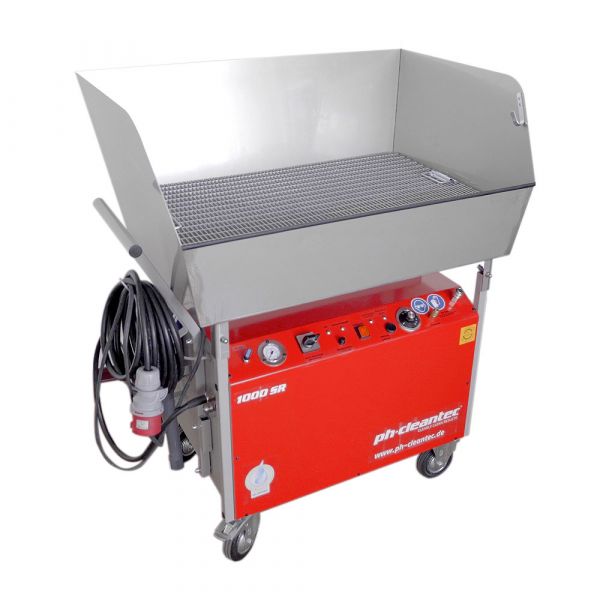
Low-pressure hot-water cleaning from ph-cleantec
The ph-cleantec cleaning system combines high temperatures of up to 95 °C with low pressure (3 – 7.5 or 3 – 14 bar). This method is therefore particularly suitable for removing greasy and oily contamination on complex or sensitive surfaces.
Benefits:
- Efficient cleaning: The high temperature loosens greases and oils effectively, while the low pressure gently carries the contamination away. Thanks to various nozzles, even complex surfaces can be cleaned without any problem and efficiently. Work is therefore frequently faster and more thorough than with conventional methods. That saves expensive working time.
- Resource-saving: The water consumption is only 1.8 or 2.8 litres per minute, and the cleaning medium can be reused in a circuit. Chemicals are needed at most in the form of an alkaline cleaner in low concentration (1–3%). That saves expensive chemicals.
- Environmentally friendly: Through the low use of water and chemicals and the recycling, environmental impact and disposal costs are minimised.
- Occupational safety: Health risks for employees are minimised, since no aggressive chemicals such as solvents or perchloroethylene are used.
- Economical: Through the fast cleaning and the minimal resources, the method is particularly cost-efficient.
Areas of application:
- Parts cleaning of small to large components
- Especially oily and greasy contamination, and complex and sensitive surfaces
- Cleaning of machine tools with their own cooling lubricant
Ultrasonic cleaning
Ultrasonic cleaning uses high-frequency sound waves that generate cavitation bubbles in a liquid. When these bubbles collapse, microjets are created that loosen contamination from the surface.
Benefits:
- Deep cleaning: Ideal for complex geometries and hard-to-reach spots
- Gentle treatment: Suitable for sensitive materials, since no mechanical stress occurs.
- High degree of cleanliness: Achieves a very high level of cleanliness, especially with fine or complex components.
Areas of application:
- Precision mechanics, e.g. the watch industry, right up to large components and motors
- Medical technology and biotechnology
- Cleaning of electronic components
Comparison: ph-cleantec vs. ultrasonic cleaning
|
Criterion |
ph-cleantec |
Ultrasonic cleaning |
|---|---|---|
|
Cleaning principle |
Hot-water low pressure |
High-frequency sound waves |
|
Water consumption |
Very low, with recycling |
Low to medium |
|
Use of chemicals |
Use of alkaline cleaners in low concentrations possible |
Immersion baths with suitable chemicals, e.g. acids, alkaline, paint-stripping, neutral or surfactant-based |
|
Residues |
Primary contamination is collected in the parts-cleaning tray Problematic if work is not done carefully and contamination is “overlooked” |
Primary contamination remains in the cleaning solution, may have to be skimmed off Problematic if air bubbles remain, e.g. in blind holes – no cleaning then takes place there |
|
Surface protection |
Very good, low pressure |
Very good, no mechanical stress |
|
Energy consumption |
Gering |
Medium to high |
|
Mobility |
High: compact and mobile units |
In industrial use generally stationary |
|
Availability / logistics |
High, as mobile and ready for use within a minute |
High, but travel times, possibly removal and reinstallation times |
|
Costs |
Low acquisition costs; low running costs; savings in working time and chemicals and disposal |
Considerably higher acquisition costs, considerably higher costs for cleaning chemicals and disposal |
Conclusion: when is which method better?
ph-cleantec is particularly suitable when:
- Sensitive components have to be cleaned
- Complex geometries and hard-to-reach spots have to be cleaned
- An environmentally friendly and resource-saving method is desired
- Cleaning is to be carried out with minimal use of chemicals
- An economical and pragmatic solution is needed
- Large components or entire machines need to be cleaned
Ultrasonic cleaning is advantageous when:
- A very high level of cleanliness is required
- Complex geometries and hard-to-reach spots have to be cleaned
- Sensitive materials are to be treated without mechanical stress
- The same parts need to be cleaned over and over again.
For many industrial applications, low-pressure hot-water cleaning from ph-cleantec offers an efficient, environmentally friendly and cost-effective alternative to ultrasonic cleaning. However, the choice of the suitable process depends on the specific requirements and circumstances. We are happy to demonstrate our method to you – without obligation and at your works. Call us on 0711-518 0600 or fill in the contact form, and we will get back to you shortly.
See the difference in practice
We are happy to come to your company with the right unit – without obligation and free of charge.