
Alternative to the high-pressure cleaner
In industrial cleaning, companies face a choice between various processes. Two frequently compared methods are the low-pressure hot-water cleaning from ph-cleantec and the classic high-pressure cleaner. Both have their justification — the decisive difference lies in pressure, temperature and consumption.
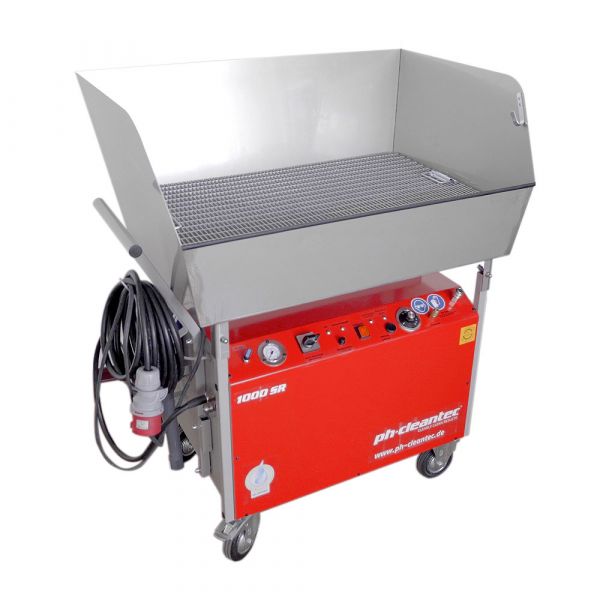
Low-pressure hot-water cleaning from ph-cleantec
The ph-cleantec cleaning system combines high temperatures of up to 95 °C with low pressure (3 to 14 bar). It is not the pressure but the temperature that loosens greases and oils — the low pressure is sufficient to gently transport away the loosened contamination.
- Efficient cleaning: At 95 °C, greasy and oily contamination is dissolved quickly and efficiently, whereas a conventional high-pressure cleaner tends to blast it off and spread it around. Diesel-heated high-pressure cleaners are more effective here, but need a great deal of energy.
- Gentle: With 3 to 7.5 or 14 bar instead of 100 to 500 bar, the risk of damage to sensitive components, seals and electronics is eliminated.
- Resource-saving: Only 1.8 to 2.8 litres of water per minute — compared with usually well over 50 litres for the high-pressure cleaner in industrial use. With recycling in a circuit, consumption falls further.
- Economical: Up to 90 % less water, chemicals and disposal costs.
- Mobile: The ph-cleantec units are mobile and can therefore be used on site – this often saves time for removal and reinstallation, for travel times to the wet room, for putting on the protective suit and much more.
The high-pressure cleaner
The high-pressure cleaner works with high water pressure of typically 100 to 500 bar. The cleaning effect arises primarily mechanically through the impact of the water jet.
- Mechanical action: Well suited to coarse, stuck-on contamination on robust surfaces.
- Widespread: The obvious choice for many outdoor and coarse cleaning tasks.
Comparison: ph-cleantec vs. high-pressure cleaner
| Criterion | ph-cleantec | High-pressure cleaner |
|---|---|---|
| Cleaning principle | Hot water at low pressure | Cold water at high pressure |
| Pressure | 3 – 14 bar | 100 – 500 bar |
| Temperature | up to 95 °C | mostly cold |
| Water consumption | 1.8 – 2.8 l/min, with recycling | 50 – 100 l/min (industry) |
| Grease and oil dissolving | Very good through temperature | Limited, often only spreading |
| Surface protection | Very good, no risk of damage | Risk for sensitive parts and electronics |
| Use on electronics | Possible with suitable IP class | Critical |
| Costs | Low running costs, fast amortisation | Higher water and disposal effort |
| Mobility | Mobile – usable directly on site | Mostly location-bound (wet room, connections) |
Conclusion: when is which method better?
ph-cleantec is particularly suitable when
- greasy or oily contamination has to be loosened
- sensitive components, seals or electronics must not be damaged
- large components or whole machines are to be cleaned
- complex surfaces, blind holes and cavities are to be cleaned
- water, chemicals and disposal costs are to be saved
The high-pressure cleaner is advantageous when
- coarse, stuck-on contamination on robust surfaces is to be removed
- no sensitive components are involved
- pure outdoor or coarse cleaning is sufficient
For many industrial applications — especially with grease and oil, sensitive parts and in the machine environment — low-pressure hot-water cleaning from ph-cleantec is the gentler, more thorough and more economical alternative. See for yourself – in a direct comparison at your works.
High-pressure cleaner or low-pressure hot-water cleaning? Frequently asked questions
What is the best alternative to a high-pressure cleaner in industry?
Why does 95 °C hot water often clean better than high pressure?
Does the method use less water than a high-pressure cleaner?
Is high-pressure cleaning suitable for sensitive components?
Does low-pressure hot-water cleaning produce splash-back and aerosols?
When is a high-pressure cleaner still useful?
See the difference in practice
We are happy to come to your company with the right unit – without obligation and free of charge.
Request a free demonstrationCalculate amortisation