
Alternative to dry-ice cleaning
In industrial cleaning, companies face a choice between various processes. Two proven methods are cleaning with low-pressure hot-water cleaners from ph-cleantec and dry-ice cleaning. Both processes offer specific benefits, depending on the respective requirements and areas of application.
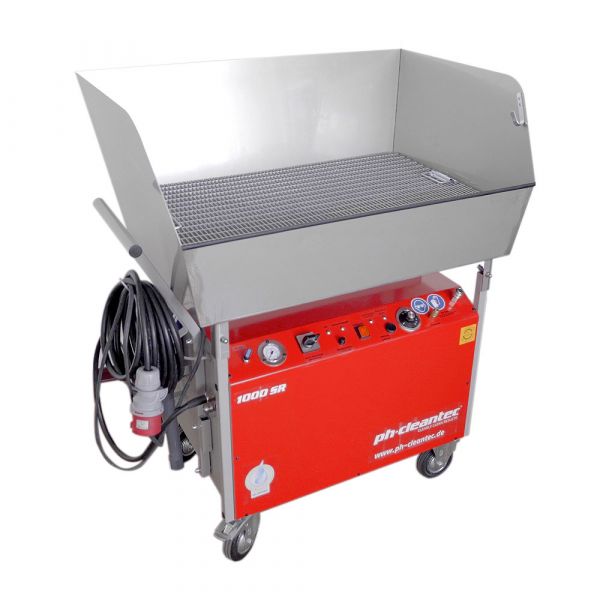
Low-pressure hot-water cleaning from ph-cleantec
The ph-cleantec cleaning system combines high temperatures of up to 95 °C with low pressure (3–7.5 or 3–14 bar). This method is therefore particularly suitable for removing greasy and oily contamination on sensitive or complex surfaces.
Benefits:
- Efficient cleaning: The high temperature loosens greases and oils effectively, while the low pressure gently removes the contamination. Work is therefore faster and more thorough than with conventional methods. That saves expensive working time.
- Resource-saving: The water consumption is only 1.8 or 2.8 litres per minute, and the cleaning medium can be reused in a circuit. Chemicals are needed at most in the form of an alkaline cleaner in low concentration (1–3%). That saves expensive chemicals.
- Environmentally friendly: Through the low use of water and chemicals and the recycling, environmental impact and disposal costs are minimised.
- Occupational safety: Health risks for employees are minimised, since no aggressive chemicals such as solvents are used.
- Economical: Through the fast cleaning and the minimal resources, the method is particularly cost-efficient.
Areas of application:
- Parts cleaning of small to large components
- Especially complex surfaces and greasy and oily contamination
- Cleaning of machine tools with their own cooling lubricant, or whole systems in machining, in the transport sector and in the food industry
Dry-ice cleaning
Dry-ice cleaning uses CO₂ pellets that are blasted at -78.5 °C onto the surface to be cleaned. On impact, the dry ice sublimates and removes contamination without leaving residues.
Benefits:
- Dry cleaning: Ideal for sensitive electronics or areas where moisture has to be avoided.
- No secondary residues: Since the dry ice sublimates completely, no secondary waste remains.
- Gentle on surfaces: The method is not abrasive and therefore does not damage the surfaces.
- Versatile: Suitable for removing paint, coatings, oils, greases and other stubborn contamination.
Areas of application:
- Cleaning of machines and systems in the food industry
- Removal of coatings and paints in the automotive industry
- Cleaning of moulds in plastics processing
Comparison: ph-cleantec vs. dry-ice cleaning
|
Criterion |
ph-cleantec |
Dry-ice cleaning |
|---|---|---|
|
Cleaning principle |
Hot-water low pressure |
Cold thermal shock |
|
Water consumption |
Low, with recycling |
No water consumption |
|
Use of chemicals |
Use of alkaline cleaners in low concentrations possible |
None |
|
Residues |
Primary contamination is collected; no secondary contamination |
Primary contamination ends up on the floor or in the workshop; no secondary contamination |
|
Surface protection |
Very good, low pressure |
Very good, not abrasive |
|
Energy consumption |
Low |
Low for the cleaning itself considerable for CO₂ production |
|
Mobility |
High, units are compact and mobile |
High, but dependent on CO₂ supply and provision of a dedicated compressor |
|
Availability / logistics |
High, within a minute |
Requires separate procurement of dry ice – generally 1–2 days – and the provision of a dedicated compressor; preparation of the actual cleaning run 30–60 minutes. |
|
Health/ Occupational safety |
No restrictions safety glasses and safety shoes |
Considerable noise exposure; Ear protection, safety glasses and safety shoes |
|
Costs |
Low acquisition costs; low running costs; savings in working time and chemicals |
High acquisition costs for the dry-ice blasting unit; very high acquisition costs for a compressor; high running costs for CO₂ and working time |
Conclusion: when is which method better?
For many industrial applications, low-pressure hot-water cleaning from ph-cleantec offers a fast and thorough, and at the same time environmentally friendly and cost-effective, alternative to dry-ice cleaning. However, the choice of the suitable process depends on the specific requirements and circumstances.
ph-cleantec is particularly suitable when:
- Immediate availability without prior planning and considerable logistics is desired
- A fast and uncomplicated solution is sought – in a direct practical comparison ph-cleantec was 5× faster than dry ice, and no logistics whatsoever were needed beforehand
- An environmentally friendly and resource-saving method is desired
- A pragmatic and economical solution with fast amortisation is sought
- Metal components or whole machines and systems are to be cleaned, e.g. in maintenance or in production
Dry-ice cleaning is advantageous when:
- Moisture has to be avoided
- Electronic parts are to be cleaned, e.g. control boxes
In many cases where dry ice brings good results, low-pressure hot-water cleaning is an at least equally suitable and, in any case, considerably more cost-effective alternative. Get advice or request a demonstration.
See the difference in practice
We are happy to come to your company with the right unit – without obligation and free of charge.