
Alternative to the cold wash table
In industrial parts cleaning, companies face a choice between various processes. Two common methods are the use of cold or bio wash tables and the hot-water low-pressure cleaning from ph-cleantec. Both processes offer specific benefits, depending on the respective requirements and areas of application.
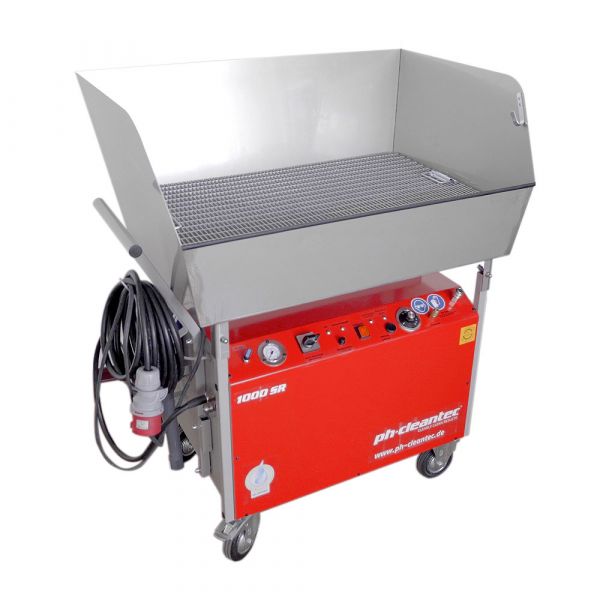
Hot-water low-pressure cleaning from ph-cleantec
The ph-cleantec cleaning system combines high temperatures of up to 95 °C with low pressure (3–7.5 or 3–14 bar). This method is particularly suitable for removing greasy and oily contamination on sensitive or complex surfaces. The units are mobile, usable practically anywhere and immediately, and are mostly used for manual cleaning.
Benefits:
- Efficient cleaning: The high temperature loosens greases and oils effectively, while the low pressure gently removes the contamination. Thanks to various nozzles, even complex surfaces right up to cavities and deep blind holes can be cleaned in the shortest time and yet thoroughly.
- Resource-saving: Unlike cold and bio wash tables, ph-cleantec cleans with water, possibly with the addition of small quantities of alkaline cleaner. Consumption is minimal, since the medium is run in a circuit.
- Environmentally friendly: Through the low use of chemicals and the recycling, the environmental impact is minimised, and consequently the disposal costs too.
- Occupational safety: The method carries practically no health risks, since no hazardous chemicals are used and no droplet clouds arise.
- Economical: Through the fast cleaning and the minimal resources, the method is particularly cost-efficient.
Areas of application:
- Parts cleaning of large and small components, often in servicing and maintenance
- Machining industry and metalworking, car workshops, commercial-vehicle workshops, municipal depots, shipyards, etc.
Cold and bio wash tables
Cold wash tables generally use solvents at room temperature, while bio wash tables rely on microbiological cleaning agents. Both systems are stationary and require manual cleaning.
Benefits:
- Easy handling: Familiar technology with little training effort.
- Low acquisition costs: Generally inexpensive to purchase.
Disadvantages:
- High chemical consumption: Regular replacement or refilling of cleaning agents required.
- Longer cleaning times: Cleaning requires considerably more time and effort.
- Environmental and health aspects: The use of solvents in cold wash tables is harmful to health and requires special disposal.
Microbiological cleaning agents are sensitive (e.g. to petrol) and must be kept at 36 °C all year round, even when the units are not in use.
Stationary: Parts to be cleaned have to be removed and transported to the wash table.
Comparison: ph-cleantec vs. cold and bio wash tables
|
Criterion |
ph-cleantec |
Cold/bio wash tables |
|---|---|---|
|
Cleaning principle |
Hot-water low pressure |
Solvents or microbiological agents |
|
Cleaning efficiency |
High, even with complex surfaces, e.g. deep blind holes, thanks to special nozzles |
Good, but increasingly limited the more complex the surfaces |
|
Water consumption |
Very low, with recycling |
None, chemicals instead |
|
Use of chemicals |
Use of alkaline cleaners in low concentrations possible |
High, especially as regular replacement is required |
|
Residues |
Primary contamination is collected; no secondary contamination |
Primary contamination ends up in the cleaning medium; “disposal” by microbiology; considerable secondary contamination |
|
Surface protection |
Very good, low pressure |
Good, dependent on solvents |
|
Availability / logistics |
High, within a minute and on site |
Immediate, but requires removal of the parts |
|
Energy consumption |
Low, only during use |
Low with the cold wash table |
|
Mobility |
High, units are compact and mobile |
Limited, stationary |
|
Costs |
Higher acquisition costs; but low running costs; significant savings in working time, for chemicals, and for disposal |
Low acquisition costs, but high running costs for refilling or replacing the chemicals and their disposal, and considerably longer cleaning times as well |
Conclusion: when is which method better?
ph-cleantec is particularly suitable when:
- Sensitive and/or complex components have to be cleaned
- An environmentally friendly and health-friendly method is desired
- The use of toxic solvents or expensive chemicals is to be avoided
- Cleaning is to be fast, thorough and at the same time cost-effective
Cold and bio wash tables are advantageous when:
- A simple, familiar technology is preferred
- Low acquisition costs are the priority
For many industrial applications, hot-water low-pressure cleaning from ph-cleantec offers an efficient, environmentally friendly and cost-effective alternative to cold and bio wash tables. By doing without toxic or expensive chemicals, not only can a lot of money be saved, but health risks from inhaling toxic solvents are also excluded.
However, the choice of the suitable process ultimately depends on the specific requirements and circumstances. Find out more and request a no-obligation demonstration – call us on 0711-518 0600, or click on the “Contact form” button. We will get back to you shortly.
See the difference in practice
We are happy to come to your company with the right unit – without obligation and free of charge.