
Component degreasing
REQUIREMENTS
When degreasing components before powder coating or wet painting, the requirements for surface cleanliness are particularly high, typically 40–42 mN/m (millinewtons per metre). This also extends to corners and bores, and applies to larger, heavy parts just as much as to small, delicate ones.
In recent years, environmental and health protection and workplace safety have also come increasingly to the fore.
The process must, of course, also be reliable and cost-effective in day-to-day operation, and the initial investment must stay “within budget”.

CONVENTIONAL METHODS
Large production runs are usually first degreased in immersion baths, then phosphated and then dried with compressed air or hot air, often as part of fully automated processes.
For small runs, however, this effort is often not worthwhile, and in these cases degreasing, phosphating and drying are done by hand. Degreasing usually relies on high-pressure cleaners with the addition of appropriate chemicals, carried out in special (and expensive) wash rooms, sometimes with corresponding equipment (protective suit).
OUR SOLUTION
With low-pressure hot-water cleaning, both small and large workpieces can be degreased ideally and reliably. Small parts up to 80 kg can be cleaned in the parts-cleaning level (mounted tray) of a 1000 or 1500 SR, larger parts (up to 1 t per m²) in correspondingly large custom trays.
The low pressure of 3–7.5 or 3–14 bar is enough to carry away contamination; the high temperatures of up to 95 °C are ideal for dissolving greases.
Extensive trials at customers’ sites showed that cleaning with deionised water already delivers optimal results. All tests, such as the cross-cut test, salt-spray test and drop test, were passed without any problems.
By adding suitable cleaning agents with temporary corrosion protection, phosphating can also be dispensed with, so that an entire process step is eliminated and working time, chemical consumption and process risks are significantly reduced.
In addition, the hot-water cleaning heats the parts, so that – especially for smaller and flat parts – drying can be reduced to blowing off moisture edges. Large parts of the surfaces dry “by themselves”. This again saves working time as well as (expensive) compressed air.
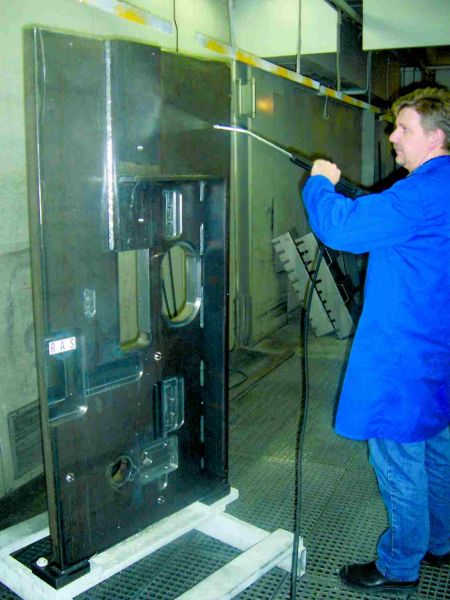
With the right chemistry, phosphating can be dispensed with, and large parts of the surface dry thanks to the high working temperature.
In terms of results, three work steps – degreasing, phosphating and drying – are thus reduced to (more or less) a single process step. Our customers regard this as a significant competitive advantage for small production runs.
There are also considerable savings in chemicals: depending on the model, low-pressure hot-water cleaning devices have a throughput of up to 1.8 litres/minute (1000 range) or up to 2.8 litres/minute (1500 range), whereas high-pressure cleaners use at least 20–30 litres/minute. To achieve the same concentration, a high-pressure cleaner therefore needs at least 10 times as much chemistry. In addition, with low-pressure hot-water cleaning devices the cleaning medium can be run in a closed loop, which is often not the case with high-pressure cleaners. If the cleaning medium is run in a loop just 10 times, a high-pressure cleaner therefore needs 100 times as much chemistry as a low-pressure hot-water cleaning device – a massive saving at today’s chemical prices!
This also makes the ph-cleantec method not only exceptionally cost-effective but also particularly environmentally friendly and easy on health.
YOUR BENEFITS
- Efficiency: fast, process-reliable degreasing even of complex surfaces, corners and edges, bores etc.
- Process-reliable: all tests, such as the drop test, salt-spray tests and cross-cut test, passed without any problems.
- Working time: fast, efficient degreasing.
- With the right cleaning agent, phosphating can be dispensed with – saving working time and chemicals and increasing process reliability.
- Thanks to hot-water cleaning, large areas dry by themselves. Often only corners and lower edges then need blowing out – saving working time and compressed air.
- In terms of results, three steps – degreasing, phosphating and drying – in (almost) one!
- Cost-effective: considerable savings in working time and in chemicals – the cleaning medium can be recycled many times over – and disposal.
- Thanks to various nozzles, extremely flexible and suitable for all kinds and sizes of components. In combination with the stationary 1000 SRS tray, also suitable for large parts.
- Low investment, especially for smaller parts; a separate wash room with an oil separator etc. is not needed. This also saves space.
- No damage to sensitive parts, thanks to the low pressure.
- No splash-back, no droplet clouds, no aerosols.
- Occupational and environmental protection, chemicals: little or no chemistry, especially as it can be recycled; this protects the environment, increases workplace safety and reduces procurement and disposal costs.
- In summary: exceptionally low investment and (significantly) lower running costs for chemicals and working time, yet high efficiency and process reliability.
DOWNLOAD
Powder coating – JOT 1/2020, pages 30 to 31 (PDF)SEE ALSO
Technical article: degreasing before powder coating
Video: component degreasing
Amortisation calculator
Test your parts in a free demonstration
We clean with your specific contamination on site – so you see the result directly.
Request a free demonstrationCalculate amortisation for your case