
Glass-bead residues before further coating
REQUIREMENTS
In series production, components are often glass-bead blasted before coating to achieve optimal surface pre-treatment in terms of adhesion and cleanliness.
In some cases the glass-bead residues adhere very strongly to the blasted parts and are hard to remove. Glass-bead residues can accumulate especially in uncovered threaded holes and undercuts. If, for example, threads that still carry residues are then coated, the threads become unusable because the residues are trapped under the coating. The parts have to be reworked or scrapped.
CONVENTIONAL METHODS
Until now, attempts were made to remove the residues by immersing the components in a solvent-containing liquid and then blowing them out with compressed air. This only partly succeeded and thus led to relatively high scrap rates.
OUR SOLUTION: LOW-PRESSURE HOT-WATER CLEANING
Our devices work with low pressure – up to 7.5 or up to 14 bar – and high temperatures. With our nozzles, even hard-to-access spots can be cleaned easily and in the shortest time.
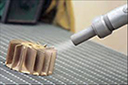
Cleaning is usually done manually, as shown on the right, but our devices can also easily be integrated into automated processes; see the case report on automation for this.
YOUR BENEFITS
- Time savings/efficiency: deposits on components can be removed residue-free and in the shortest time using hot water. Time savings are often 80–90%.
- Quality: even hard-to-access spots can easily be reached using various interchangeable tools (see accessories).
- Occupational and environmental protection/chemicals/costs: the use of harmful and expensive solvents is eliminated; hence a considerable cost reduction, and the whole disposal issue is avoided.
- Environmental protection/resources: considerably fewer resources, e.g. small amounts of water instead of large amounts of solvents. The process water can be run in a closed loop for weeks, hence reduced waste-water disposal too.
- Mobility: the devices are mobile, so cleaning directly “on site” is easily possible. This saves travel and transfer times.
- Efficiency: the high temperature of up to 95 °C helps the workpieces dry quickly.
- Additives: with suitable cleaning agents, the process can be used for iron phosphating, providing better corrosion protection through iron ions.
- Investment: significantly lower investment costs compared with other methods.
- Versatile use of the hot-water cleaning devices: also for machine and parts cleaning.
- Cost-effectiveness: efficient work, low investment, barely any running costs, and high time savings.
AMORTISATION
Coating is usually the last production step before packaging and selling. Having to sort out almost-finished workpieces – after almost all other steps such as (injection) moulding, turning, milling, thread machining etc. have already been carried out – is unwelcome and involves comparatively high costs.
Our technology therefore pays for itself within a very short time: assuming scrap costs of just €50 per part, a 1000 SR device pays for itself after just 130–150 fewer scrapped parts.
You are welcome to make a more precise calculation for your company using our amortisation calculator.
DOWNLOAD
Removing glass-bead residues (PDF)Test your parts in a free demonstration
We clean with your specific contamination on site – so you see the result directly.
Request a free demonstrationCalculate amortisation for your case