
Cleaning diesel particulate filters
Diesel particulate filters (DPF) are central components of modern exhaust-gas cleaning. Regular, professional cleaning maintains performance, reduces emissions and lowers operating costs. But what actually matters in cleaning diesel particulate filters, which methods are there, and what are their advantages and disadvantages?
Challenges in cleaning diesel particulate filters
Diesel particulate filters are complex components made of sensitive materials that can be coated with the most varied contamination, e.g. soot, oil and lubricant films, ash and much more – this special combination leads to special challenges:
- Sensitive materials: DPF ceramics, high-performance matrix and seals are sensitive to wrong temperatures, chemical agents or rough mechanical stress.
- Risk of defects: Mechanical stress, high temperatures or aggressive cleaning processes can quickly damage individual components.
- Complex contamination: Soot, oil and lubricant films, ash as well as blockages can require different cleaning approaches.
- Costs/downtimes: Unprofessional cleaning can lead to longer downtimes and higher follow-up costs.
- Environmental and health aspects: Pollutants, solvents and residual substances have to be disposed of safely.
Conventional methods for cleaning diesel particulate filters and their respective advantages and disadvantages
| Method | Advantages | Disadvantages |
|---|---|---|
| Mechanical revision and regeneration (in the vehicle) | Direct treatment, quick intermediate cleaning possible. | Not all defects can be remedied; stress on the DPF components from high temperatures; increased wear risk. |
| Manual cleaning (without removal) – shown in many do-it-yourself videos, mostly with A1 brake cleaners in spray cans | Direct treatment, quick intermediate cleaning possible. | Not all defects can be remedied; increased risk of damage, time-consuming |
| Manual cleaning (outside the vehicle) – mostly on cold or bio wash tables | Thorough removal of ash and soot, good pre-cleaning for further steps. | Removal, transport to the wash bay and reinstallation cost time and carry the risk of mechanical damage; the actual cleaning is also time-consuming; considerable costs for chemicals and their disposal |
| Chemical cleaning | Effective for certain contamination; targeted adaptation to the respective filter type possible. | Time-consuming removal, transport to the wash bay and reinstallation; environmental and health risks; residues and the particularities of the respective filter material have to be considered. |
| Thermal cleaning (pyrolysis, i.e. “burning off” the particles) | Deep cleaning, soot is oxidised. | High heat acts aggressively on ceramics; high cost and time expenditure; considerable investment for a special furnace; risk of component damage. |
Low-pressure hot-water cleaning as a (more) cost-effective and highly efficient alternative
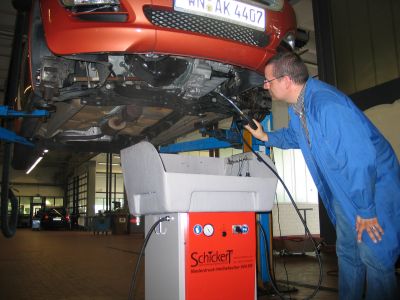
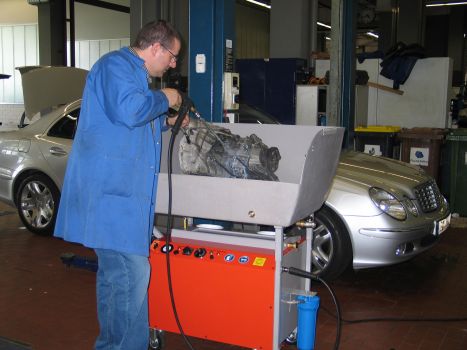
In low-pressure hot-water cleaning, cleaning is essentially done with (tap) water heated to 95°C. Through the high temperatures, greases, oils, abrasion, but above all soot and ash too, are loosened quickly and efficiently. Through the low pressure of “only” 7.5 or 14 bar, the removed contamination is transported away without any problem, while components are not damaged. This process can be accelerated further by adding small quantities of alkaline cleaner (soap).
Since the low-pressure hot-water units are mobile, work can be done directly on or under the body; in most cases the particulate filter therefore does not even have to be removed. In addition there are collecting trays with which the process water can be collected and recycled.
The benefits of low-pressure hot-water cleaning are thus obvious:
- Material-friendly: Low pressure spares ceramics and the DPF matrix, no damage
- Fast, thorough and efficient: Fast and yet thorough removal of soot, oil and lubricant films, mostly without removal and reinstallation, since cleaning is possible directly on the vehicle
- Even stubborn residues are cleaned off gently and thoroughly
- No solvents, but water-based: Thus environmentally friendly and health-friendly, easy handling, and minimal disposal costs
- Resource-efficient: Savings in working time, chemicals and disposal – the resources needed are small quantities of tap water and electricity, at most the addition of small quantities of alkaline cleaner (soap)
- Thus at the same time very cost-efficient – amortisation generally in a few months.
- No downtimes, no material breakage, no workplace accidents.
The only disadvantage, if any, is that a one-off investment for the purchase of the unit is required – however, the unit generally pays for itself through savings in working time and chemicals in a few months.
Use in practice
In practice, the following units are mostly used
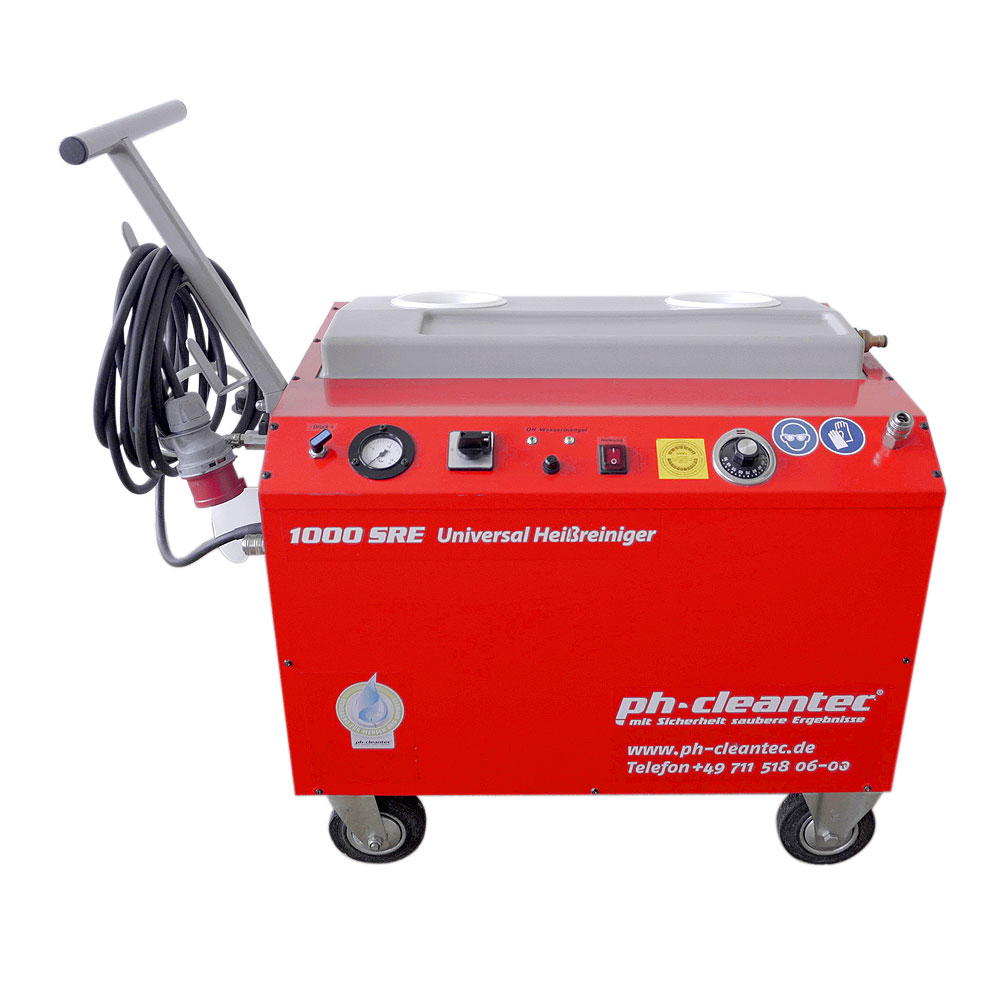
Unit 1000 SRE
Tray 1000 KW-FP
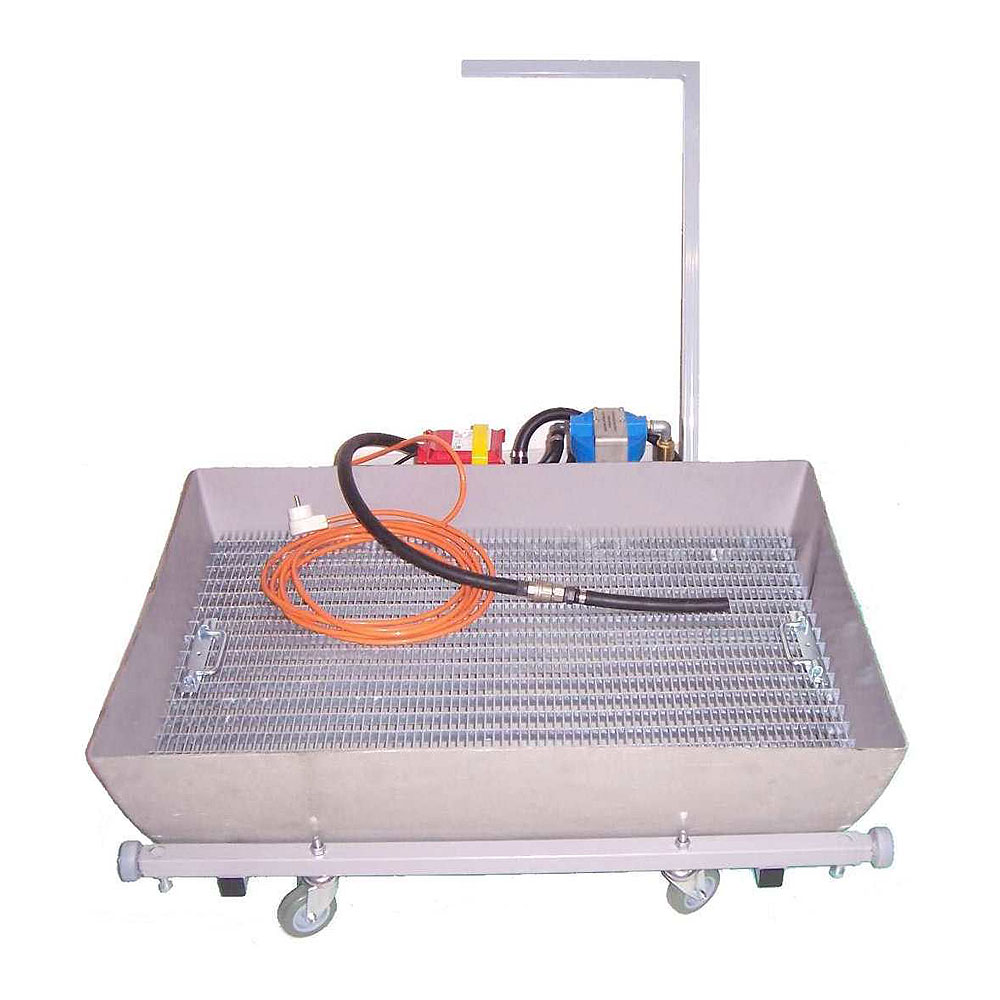
1000 SR with stainless-steel tray

Contact
You will find suitable videos for this application in our video section.
Test your parts in a free demonstration
We clean with your specific contamination on site – so you see the result directly.
Request a free demonstrationCalculate amortisation for your case