
Thermal disinfection — specialist article
Anyone who works with cooling lubricants knows the problem: you come into the production hall in the morning and it “stinks to high heaven” because the cooling lubricant has turned in one of the machine tools.
The cause of this is, as is well known, microorganisms, i.e. fungi and bacteria, which find a perfect breeding ground in the cooling lubricant (CL). These microorganisms occur essentially with water-miscible cooling lubricants and, for temperature reasons, accumulate in summer and in southern countries. The odour nuisance arises from the excretions of anaerobic bacteria.
Besides the odour nuisance, bacteria and fungi lead to further undesirable side effects: they impair the effectiveness of the cooling lubricant and thus worsen its performance properties. Occasionally pipes become clogged by fungal filaments and/or slime bacteria, and in exceptional cases even fungal growths up to the size of a cabbage form.
Targeted care pays off
Targeted care of the cooling lubricant is therefore worthwhile in any case, in order to preserve the performance properties for longer, i.e. to extend the service life of the cooling lubricant. This reduces the costs for purchasing new cooling-lubricant concentrate, the often underestimated costs for disposing of the used cooling lubricant, as well as the machine downtimes during the changeover process.
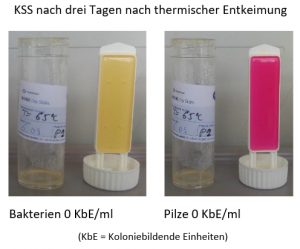
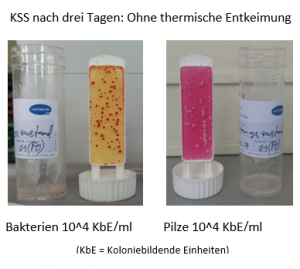
Care of the cooling lubricant in many cases includes filtering the cooling lubricant with the help of special cooling-lubricant filters as well as removing surface oils with the help of skimmers and oil separators. However, such mechanical methods are powerless against microorganisms already present. Monitoring the cooling lubricant with regard to nitrites, nitrates and the pH value likewise only allows one to establish that, or when, new measures have to be taken.
Fungi, yeasts and bacteria – and how to combat them
For combating the bacteria and fungi in the cooling lubricant, there are only a few methods. Widespread is irradiation with ultraviolet light. This works relatively easily with transparent liquids, but with cooling lubricant UV rays penetrate only superficially because of the milky consistency and of contamination. The cooling lubricant therefore has to be reduced to such a thin film that UV light can penetrate it. In practice this proves to be a major challenge, and the results in practice are often only modest: often only 60–80%, in some cases even under 50% of the bacteria and fungi present are killed.
Certainly the most widespread is the use of biocides, i.e. bactericides and fungicides. These undoubtedly have the advantage of being cost-effective and, in part, also very efficient. However, biocides are hazardous substances within the meaning of the EU CLP Regulation, which require professional and thus expensive handling.
In some respects, one thus drives out the devil with Beelzebub, because biocides can cause considerable health complaints. These range from mild inflammation of everyday wounds through skin rashes and allergies to irritation of the skin, eyes and mucous membranes. Concentrates in particular, which are increasingly used, must under no circumstances come into contact with the skin, since even the smallest splashes can lead to considerable health damage.
Avoiding biocides would therefore reduce the health risks for the employees and tend to help reduce sick leave.
Thermal disinfection
Little known, but all the more effective, is thermal disinfection, which is known in the hospital and food sectors as pasteurisation. For this, the cooling lubricant is heated to 65°C. Since proteins, and thus bacteria and fungi, are destroyed at about 62–63°C, this method is almost one hundred percent effective.
In a test series by ph-cleantec from Fellbach, thermal disinfection was examined with 107 customers using 75 different cooling lubricants. Bacteria were found with 88 customers, and fungi were also found in the cooling lubricant with 29 of the 107 customers.
Note: The proportion of fungi and bacteria before the disinfection of the respective cooling lubricant only says that a particular customer had many or few germs at a particular time; this may be due to the temperature, the application, or the age of the cooling lubricant, and says nothing about the quality of the respective cooling lubricant or about whether a particular cooling lubricant is particularly susceptible to the development of germs.
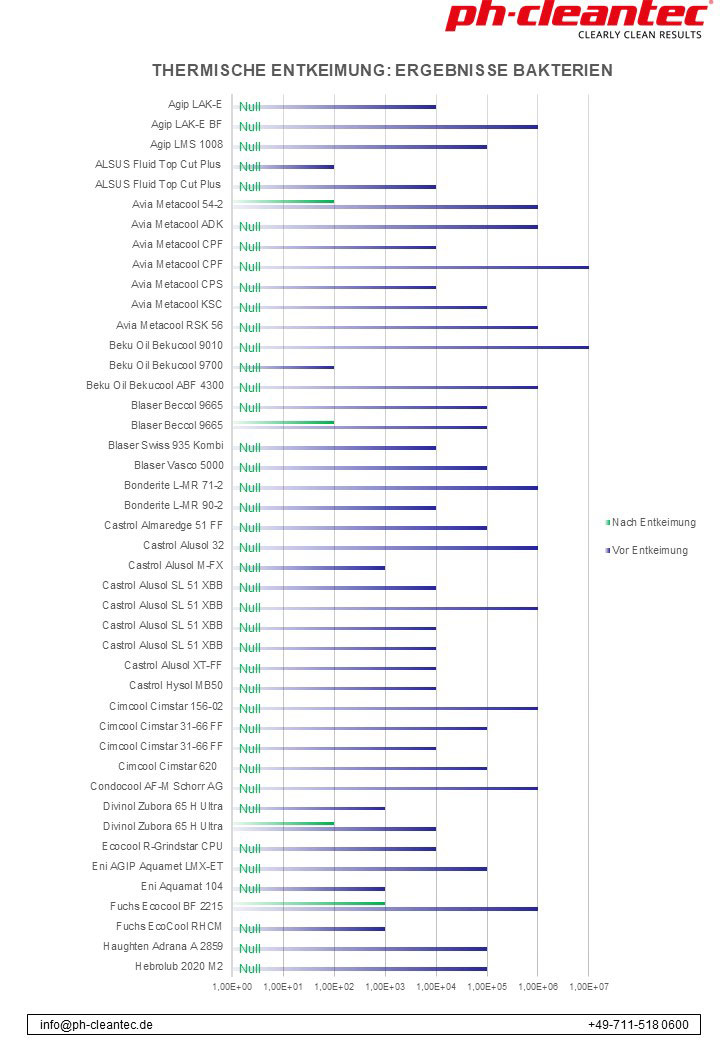
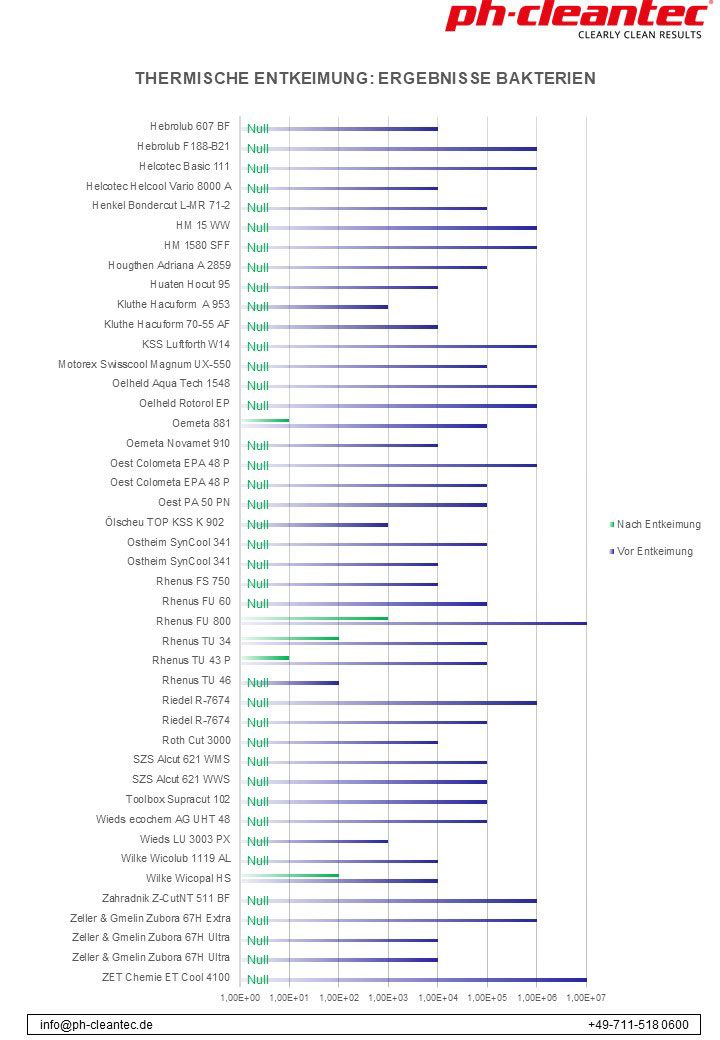
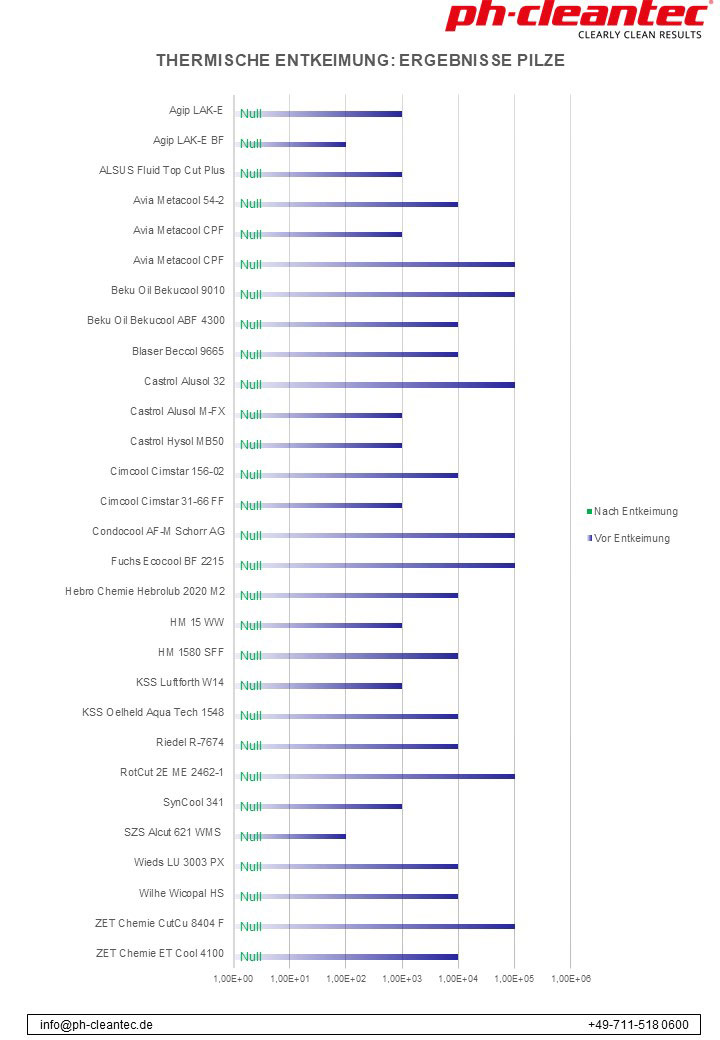
Graphs 1a, 1b and 2 show the results of thermal disinfection for various cooling lubricants in practice. This is a logarithmic scale, so 10^3 means 10 × 10 × 10 = 1000. Colony-forming units per millilitre (CFU/ml) were measured.
In 90% of cases – with 79 of 88 customers – the bacteria could be reduced to zero (graphs 1a and 1b). Only in 9 cases did any bacteria remain, but on average they could be reduced by a factor of 10^3. Even with heavy infestation – 10^6 or 10^7 bacterial germs per millilitre – no bacteria at all were found in the cooling lubricant after disinfection in 23 of 26 cases, and in the remaining cases the bacteria were reduced by a factor of 1,000 or 10,000.
Thermal disinfection was even more successful with fungi (graph 2): these were reduced to zero in all 29 cases.
Thermal disinfection in practice
From the user’s point of view, particularly relevant is that thermal disinfection works in practice and in the long term. Companies that use the system can dispense entirely with biocides, and the service life of the cooling lubricant has increased significantly since they disinfect the cooling lubricant regularly. This is also confirmed by cooling-lubricant manufacturers.
In terms of the result, thermal disinfection is thus certainly one of the most efficient methods for disinfecting cooling lubricant. Since it manages entirely without chemicals or biocides, it is also environmentally and health-friendly. Finally, thermal disinfection is exceptionally cost-effective, since only a small investment for a disinfection machine – e.g. the Thermo-EK or the 1000 SR with the disinfection option from ph-cleantec in Kernen – and minimal running costs, essentially electricity, are necessary. Disinfection should in any case be carried out during ongoing production, so that the cooling lubricant in the lines is disinfected too. This means that no downtime costs arise during disinfection.
Excursus: a worked example
This can be illustrated with a simple example: For a company with ten machine tools (MT) of 500 litres each, where the cooling lubricant is changed twice a year, the annual consumption is 10,000 litres of cooling lubricant. At a cost of €5/l of cooling-lubricant concentrate and a 6% concentration, this costs 10,000 l × 6% × €5 = €3,000. Disposal costs a further €0.12/l, giving 10,000 l × €0.12 = €1,200. On top of this come the costs of downtime: assuming the machine tools stand still for eight hours for each cooling-lubricant change, and one hour of downtime costs €100, this costs 10 MT × 2 changes per year × 8 hours × €100 = €16,000. The total costs are thus €20,200.
If the service life of the cooling lubricant can be extended by 50% through disinfection, the company saves €6,733 p.a.; if the service life of the cooling lubricant can be doubled, it saves €10,100 per year. In addition, the costs for bactericides and fungicides are saved. Finally, there are benefits that cannot be precisely quantified in monetary terms: no odour nuisance, a clean operating environment, and above all fewer health problems.
Thermal disinfection in practice – continued
In practice, the units needed for thermal disinfection are mobile and can be driven up to the respective machine tool without any problem. The cooling lubricant is drawn by the disinfection unit from the tank of the machine tool, disinfected, and then fed back into the tank of the machine tool. With a disinfection capacity of 5–6 litres per minute, a tank of, for example, 500 litres can be disinfected once in less than two hours. Integration into a central system is also possible.
Ideally, the disinfected cooling lubricant should be transferred into a germ-free container, and the machine tool thoroughly cleaned and disinfected, before the cooling lubricant is put back into the machine. However, this is hardly practical. Instead, in practice the disinfected cooling lubricant is fed directly back into the bath and mixed there with the non-disinfected cooling lubricant. Thus residual amounts of non-disinfected cooling lubricant remain in the tank of the machine tool, in particular the biofilm on the bottom and walls of the machine tool. However, this is no different with all other methods, even with biocides, so one is no worse off here.
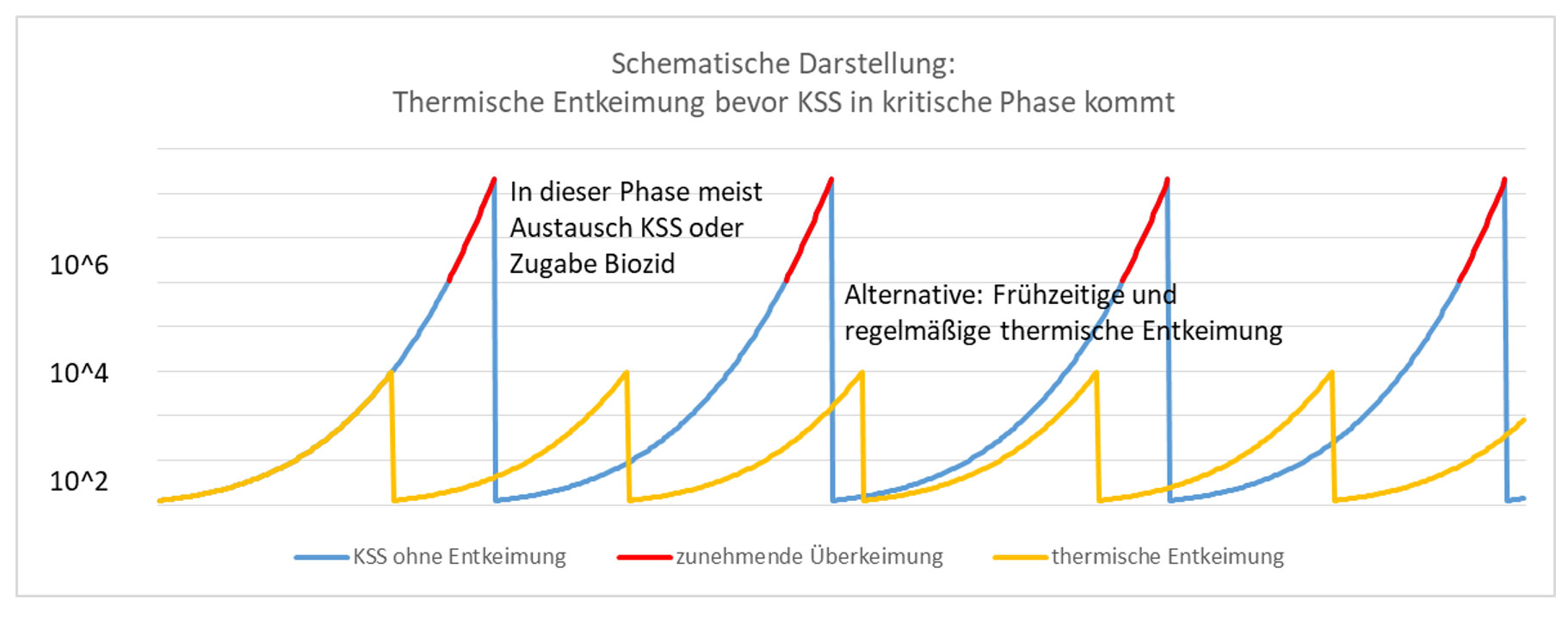
In practice, it is advisable to disinfect the cooling lubricant three times directly in succession, and to stir it up a little if possible, so that as much as possible of the germ-laden residues in the corners, lines and on the bottom is whirled up and disinfected. Thus, depending on the specific application, it will take weeks, sometimes months, until the cooling lubricant is again so heavily laden that a new disinfection becomes necessary. Nevertheless, thermal disinfection should definitely be repeated regularly, e.g. once a month, in order to prevent excessive germ formation from the outset. Since this can and should be done in the bypass, ongoing operation is not affected by it.
This can be visualised with the following schematic representation.
Summary
In summary, a considerable extension of the service life of the cooling lubricant is possible with thermal disinfection – with corresponding savings potential in the procurement and disposal of the cooling lubricant as well as in the downtimes of the machine tools. In addition, health risks for the employees as well as environmental risks can be reduced.
What our customers say
Since mid-February 2018 we have been using a 1000 SR from ph-cleantec with the thermal disinfection option. In addition to machine cleaning with the low-pressure hot-water unit, we apply this option prophylactically to disinfect the contents of the cooling-lubricant tank of the machine tools. Cleaning and simultaneous disinfection is carried out at our premises according to a worked-out plan.
Especially during the hot temperatures that have persisted for months, we have thus been able to significantly reduce the use of biocides, or dispense with them entirely, since thermal disinfection significantly reduces infestation with bacteria and fungi!
In this way, with this environmentally friendly process, staff and the environment are less burdened.
— Edelstahl Rosswag Pfinztal, Mr Broschinski, www.edelstahl-rosswag.de
Our company, Franz H. Bruder GmbH, based in Oppenau, is a manufacturer of precision parts. Two years ago, on the recommendation of Mr Willi Schüler, we purchased a hot-water cleaning unit from ph-cleantec, with which we have since cleaned our turning, grinding and milling machines.
For us this is an enormous improvement, because the deposits simply come off, and we save an enormous amount of time – I would almost say: cleaning is fun this way! We also use the unit for parts cleaning; there too we save a massive amount of working time, and we save the money for the brake cleaner that we used before.
In particular, we also use the unit for the thermal disinfection of our cooling lubricant, which we can thus leave in the machine for longer. This has allowed us to get the fungi that previously caused us problems completely under control. We can therefore only warmly recommend the ph-cleantec units – it really is a fine thing!
— Jens Schmiederer, Production Foreman, Franz H. Bruder GmbH, www.bruder-gmbh.de
Experience thermal disinfection in practice
We are happy to demonstrate thermal disinfection on your own cooling lubricant – without obligation and free of charge.
Request a free demonstrationCalculate amortisationWatch the video “Thermal disinfection”