
Cleaning in a dairy
REQUIREMENTS
When cleaning in companies that process or produce food, certain cleaning processes are prescribed for the system parts that come into contact with the food. Here, foaming acidic cleaners and alkaline passivators generally have to be used.
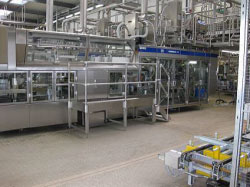
In a dairy, the majority of the operating plant consists of filling and packaging systems. The maintenance and upkeep effort for these systems is immense. Large dairies also often operate large truck fleets.

PREVIOUS TECHNOLOGY
Given the frequent damage to machines and parts, high-pressure cleaners are not used. Instead, the surroundings of the packaging systems are kept clean with a medium-pressure cleaner (MDR) at 30–70 bar, max. 100 l/min. Inside the systems, CIP (cleaning in place) processes are applied.
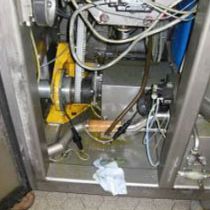
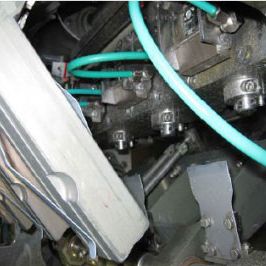
The drives of the packaging systems are highly complex and sensitive. Typically they are soiled with oils and greases and slightly with production residues. Cleaning with HDR or MDR is out of the question, since the sensitive mechanics would be damaged. Manual cleaning with brush and cloth, however, is very time-consuming and cumbersome because of the complexity of the systems, and the result is only partly satisfactory.
To make matters worse, pumps, motors and compressors sometimes cannot be dismantled during repair or maintenance because of their size, but have to be cleaned on site.
The water for cleaning is generated from the company’s own processes and is about 60°C hot. There is no disposal problem, since the drainage present in the production leads the wastewater into a central grease separator.
OUR SOLUTION
The low-pressure hot-water cleaning technology opens up new possibilities here: with the low pressure of up to 7.5 or up to 14 bar, even sensitive parts in the drive technology are not damaged.
At the same time, oils and greases in particular are loosened optimally by the high temperatures of up to 95°C.
YOUR BENEFITS
- Efficiency/quality: Fast and thorough cleaning. Thanks to various lances and nozzles, easy cleaning even of hard-to-reach or sensitive areas, e.g. the drives of the filling and packaging machines.
- Optimal accessibility: Units are mobile and largely self-contained, and can be moved from one place of use to the next.
- Easy cleaning in production: minimal splash-back effects, no droplet clouds, no aerosols and much more.
- Considerably more pleasant work than by hand or with chemicals.
- No damage to sensitive parts thanks to the low pressure.
- Cleaning medium: Hot water or deionised water, without added chemicals. Therefore:
- No contamination risk.
- Low costs for procurement and disposal.
- Spontaneous use in an emergency possible at any time.
- Disinfecting effect.
- Occupational and environmental protection: No chemicals means higher environmental compatibility, higher occupational safety and reduced costs.
- Overall: Considerably less working time when cleaning, thus fewer stoppages, better cleaning result, no chemicals, no damage.
- Comparatively low investment and hardly any running costs, but in return high efficiency and quality.
DOWNLOAD
Cleaning in a dairy (PDF)Test your parts in a free demonstration
We clean with your specific contamination on site – so you see the result directly.
Request a free demonstrationCalculate amortisation for your case