
Cleaning aircraft gearbox parts
REQUIREMENTS
In this specific application, parts installed in GE turbines had to be cleaned. The parts were made of titanium and had holes with a diameter of 0.2 to 0.7 mm.
The parts cost between €1,000 and €40,000, so the cleaning must under no circumstances damage them. What had to be cleaned off was kerosene and test fluids that had lodged in the holes, and the cleaning had to be absolutely perfect – no dirt residues whatsoever were allowed to remain.
Until now, the parts were rinsed repeatedly in a washing system with a rotating basket until a satisfactory result was achieved. Depending on the degree of contamination, several wash cycles were needed. Despite all care, this repeatedly led to damage to the parts, among other things during transport to the washing machines.
OUR SOLUTION
In the low-pressure hot-water method, greasy and oily contamination – here the kerosene and the test fluid – is cleaned with a medium heated to up to 95 °C and low pressure of up to 7.5 or 14 bar.
The gearbox parts could be cleaned ideally in the parts-cleaning level of the 1000 range. Cleaning was done with hot water with the addition of 3% of our alkaline cleaning agent B1200.
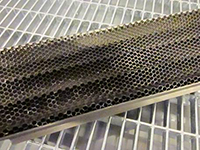
The cleaning results were better than the previous method in every respect: although cleaning was now done by hand, hand cleaning nevertheless took less time than loading the washing machine multiple times, and travel and waiting times were saved. The staff could immediately see where the critical areas were and where re-cleaning was still needed, and so achieved markedly better results much faster. In addition, the risk of damaging the parts during transport was eliminated, since the hot-water cleaning device is mobile and could therefore be used directly at the turbine.
YOUR BENEFITS
Low-pressure hot-water cleaning was the ideal solution here:
- Excellent cleaning quality, as even the especially fine holes could be perfectly cleaned and rinsed out at 95 °C.
- Thanks to the low pressure of 3 – 7.5 bar, no damage whatsoever to sensitive parts. Also the elimination of the risk of damage during transport.
- Significant savings in working time and much more efficient work, no travel times.
- Minimal splash-back, no droplet clouds, no aerosols – making it ideal for indoor use too.
- Adding 3% alkaline cleaning agent (to approx. 90 litres of process water in a 1000 SR) saves considerable chemistry compared with the washing machine (which uses many times as much process water).
- Occupational and environmental protection: no or minimal chemistry means high environmental compatibility, high workplace safety and significantly lower costs.
- Versatile use: in this case only gearbox parts were cleaned, but the device can also be used for a wide range of other applications in the workshop or directly on the aircraft, e.g. for
- Engines, landing gear, brakes, aircraft tank
- Because the device is mobile, it can also be used directly “on site”, often without even having to remove parts.
- Cost-effectiveness: low investment for the device, no follow-up costs for wash rooms, oil separators and the like, then minimal running costs for electricity and water. Amortisation often within just a few months.
In summary: low investment and minimal running costs, but perfect quality, no damage to the parts whatsoever, and enormous time savings.
DOWNLOAD
Cleaning aircraft gearbox parts (PDF)Test your parts in a free demonstration
We clean with your specific contamination on site – so you see the result directly.
Request a free demonstrationCalculate amortisation for your case