
Cleaning bores
REQUIREMENTS
Cleaning a bore from the inside often poses a particular challenge with conventional cleaning processes such as washing machines, cold wash table or ultrasonics, since contamination at the bottom of deep blind holes or on internal threads cannot be reached effectively. The problem is intensified with small diameters.
In practice, a residue-free removal of chips, oils, drawing greases and cooling lubricant from machining is generally required. Especially in maintenance, oily contamination often also has to be removed from bore holes, internal threads or cavities.
PREVIOUS TECHNOLOGY
The corresponding bores or workpieces are often cleaned with solvent-based chemicals on cold wash tables. The method is laborious, lengthy and not result-reliable.
In addition, the solvent-based chemicals are expensive and environmentally harmful, and health-damaging aerosols form.
OUR SOLUTION
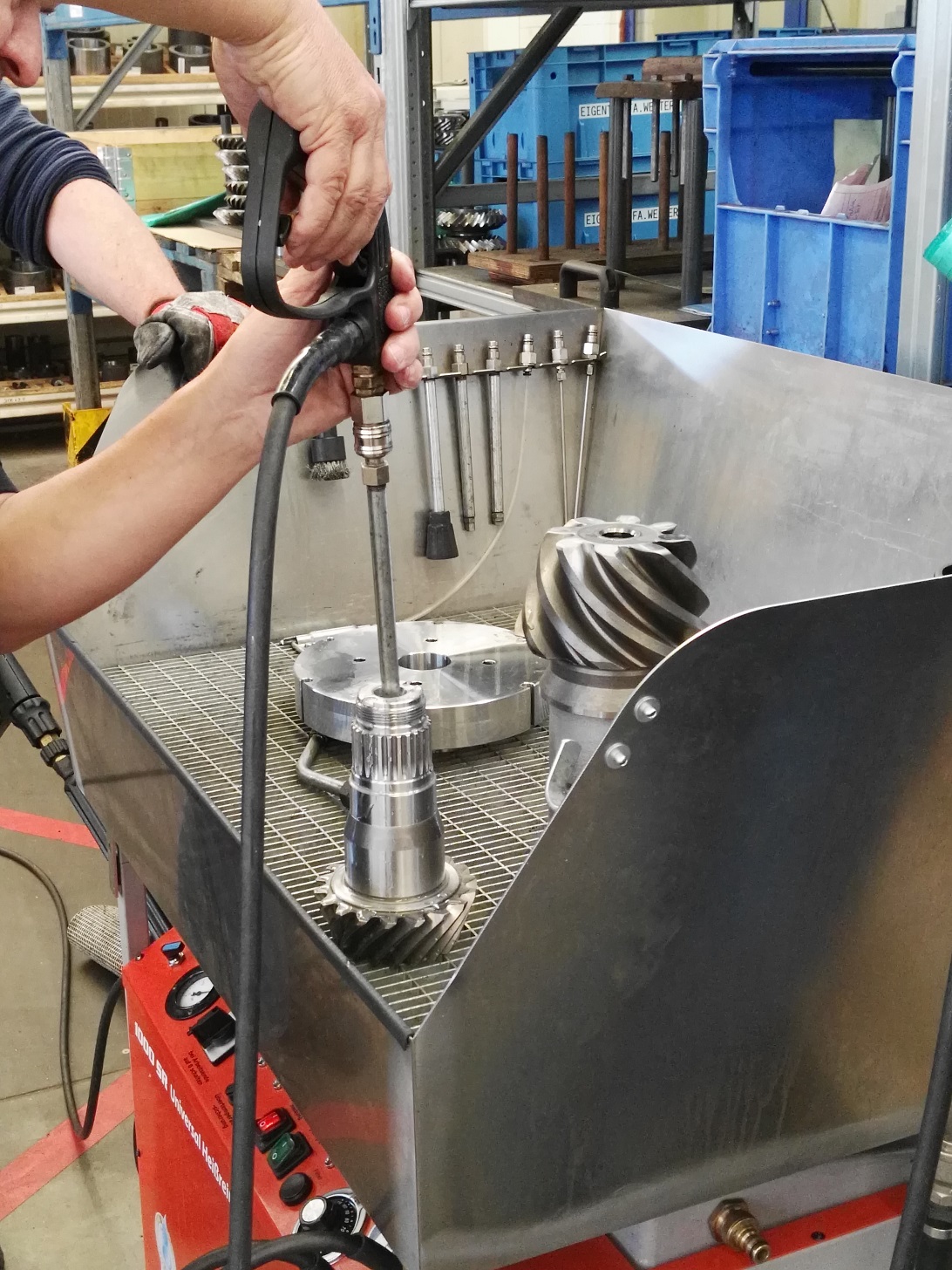
Here, low-pressure hot-water technology offers a simple, cost-effective and highly flexible alternative. The units work with low pressure (from 3 to 7.5 or up to 14 bar) and high water temperature (up to 95°C). Thanks to the low pressure, parts are not damaged and the method can be used in the workshop without people or the environment being affected.
The cleaning effect results primarily from the high temperature. The combination of high temperature and low pressure together with the right tools allows blind holes to the bottom, internal threads and even cavities to be cleaned and rinsed out quickly, efficiently and residue-free.
In most cases, (expensive and environmentally harmful) chemicals can be dispensed with, since the cleaning effect is achieved via the high temperatures.
For the internal cleaning of bores, flexible nozzles and various lances are available. With the flexible nozzles from a diameter of 2.5 mm and in almost any length, even sensitive components with curves or narrow passages in the interior can be cleaned. Thin bores can be rinsed out with needle nozzles.
Of course, the process is also suitable for the external cleaning of the components. Larger and heavy parts can be cleaned on stationary trays, whereby the cleaning medium can be run in a circuit via a special recycling process and thus reused.
In addition to process-related parts cleaning, the cleaning units can also be used in maintenance and for machine upkeep. Particularly worth mentioning is the possibility of cleaning machine tools directly with the cooling lubricant used.

YOUR BENEFITS
- Efficiency/quality: Fast and thorough cleaning, especially of greasy and oily contamination. With the right spray accessories, also easy cleaning of demanding shapes, such as internal threads and thin and deep bores right to the bottom.
- Costs: Considerable time saving compared with conventional methods, especially the cold wash table; at the same time often considerably more efficient than e.g. washing machines and cheaper than ultrasonics.
- Automation: Easy integration into semi- or fully automated production processes.
- Mobility: Cleaning on site – units are mobile and largely self-contained.
- Occupational and environmental protection, chemicals: No or only very little chemicals needed; this spares the environment, increases occupational safety and reduces costs.
- Universal possibilities of use of the hot-water cleaning units: These can be used e.g. for servicing and maintenance or for machine and parts cleaning.
- Economy: Considerably less working time when cleaning, no or hardly any chemicals.
- Overall: Comparatively low investment and hardly any running costs, but in return high efficiency and quality.
SEE ALSO:
- On the topic of internal cleaning: Application report Cleaning complex cast bodies
- Video Lüttge wind instruments
DOWNLOAD
Cleaning bores (PDF)Test your parts in a free demonstration
We clean with your specific contamination on site – so you see the result directly.
Request a free demonstrationCalculate amortisation for your case