
Cleaning heat exchangers
Contamination in the heat exchanger lowers its efficiency and increases energy consumption. The low-pressure hot-water cleaning from ph-cleantec removes deposits efficiently, gently and without aggressive chemicals – in many cases directly in the installed state and without laborious dismantling.

REQUIREMENTS
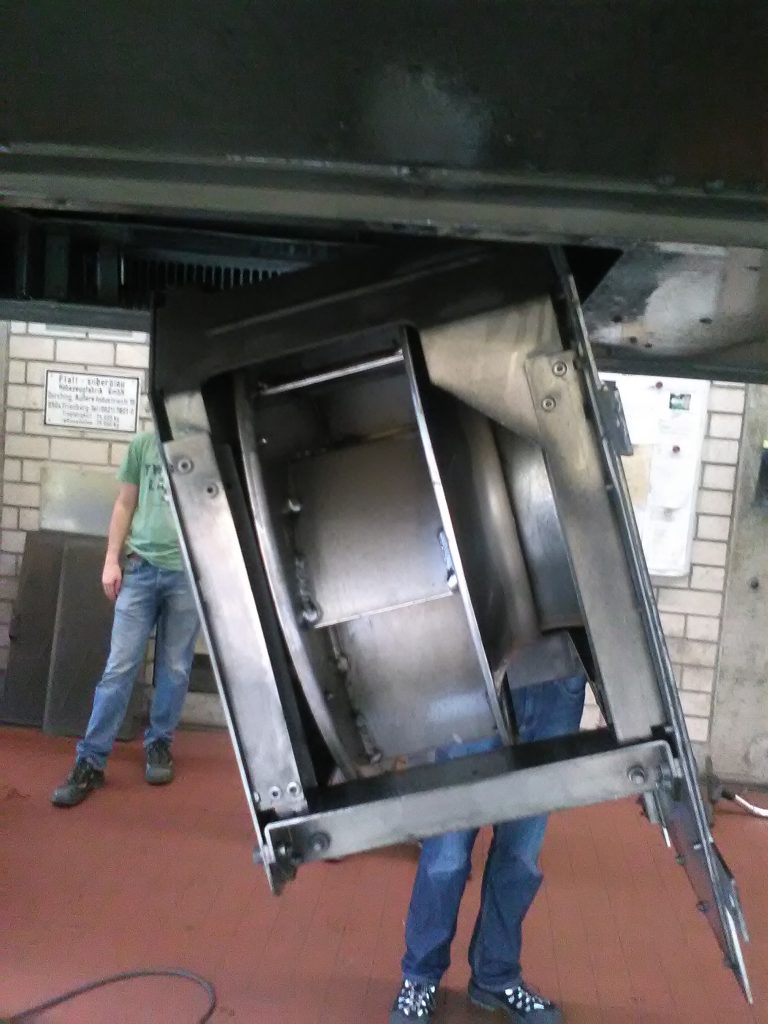
Heat exchangers are indispensable components in many industrial processes. Their task is to transfer heat from one medium to another without the two media coming into direct contact – helping to save energy or to cool or heat air and gases. In the metalworking or machining industry, they are often used to cool the cooling lubricants after their use at the cutting edge.
To achieve the temperature exchange between cold and warm medium, heat exchangers need large surfaces. This is generally achieved by fine fins. They are offered in the most varied designs and for many areas of use:
- Water coolers, charge-air coolers and fuel coolers – frequently found in automotive and mechanical-engineering plants.
- Engine-oil coolers, gearbox-oil coolers and condensers – for example in the chemical industry and in power plants.
- Evaporators and condensers in air-conditioning and refrigeration technology.
- Cooling matrices and climate-control systems in vehicles and buildings.
PREVIOUS TECHNOLOGY
Heat exchangers are particularly susceptible to contamination that impairs their efficiency. Typical deposits on the heat-transfer surfaces are:
- Limescale, primarily in water-carrying systems.
- Rust, especially in systems with metallic contact.
- Oil and grease residues from industrial processes.
- Sludge from process wastewater as well as biological films such as algae and bacteria.
These deposits act like an insulating layer and hinder heat transfer. The result is falling efficiency, higher energy consumption and sometimes overheating – which accelerates wear and can cause failures. Cleaning the fine fins must therefore be fast, thorough and at the same time damage-free, with enough flushing action to reach between the fins and without excessive pressure.
Conventional methods reach their limits here:
- Mechanical cleaning with high-pressure cleaners, brushes or sandblasters can bend and damage the sensitive fins.
- Chemical cleaning with aggressive agents or acids attacks sensitive materials such as aluminium or copper and causes high costs for chemicals, handling and disposal.
- Ultrasonic or bath cleaning is effective but expensive and time-consuming and requires removal.
- Thermal processes (pyrolysis) are stationary, require removal and high investment.
In all these cases the heat exchangers usually have to be removed and reinstalled, coded and transported to the cleaning facility and back – which costs time and increases the risk.
OUR SOLUTION: LOW-PRESSURE HOT-WATER CLEANING
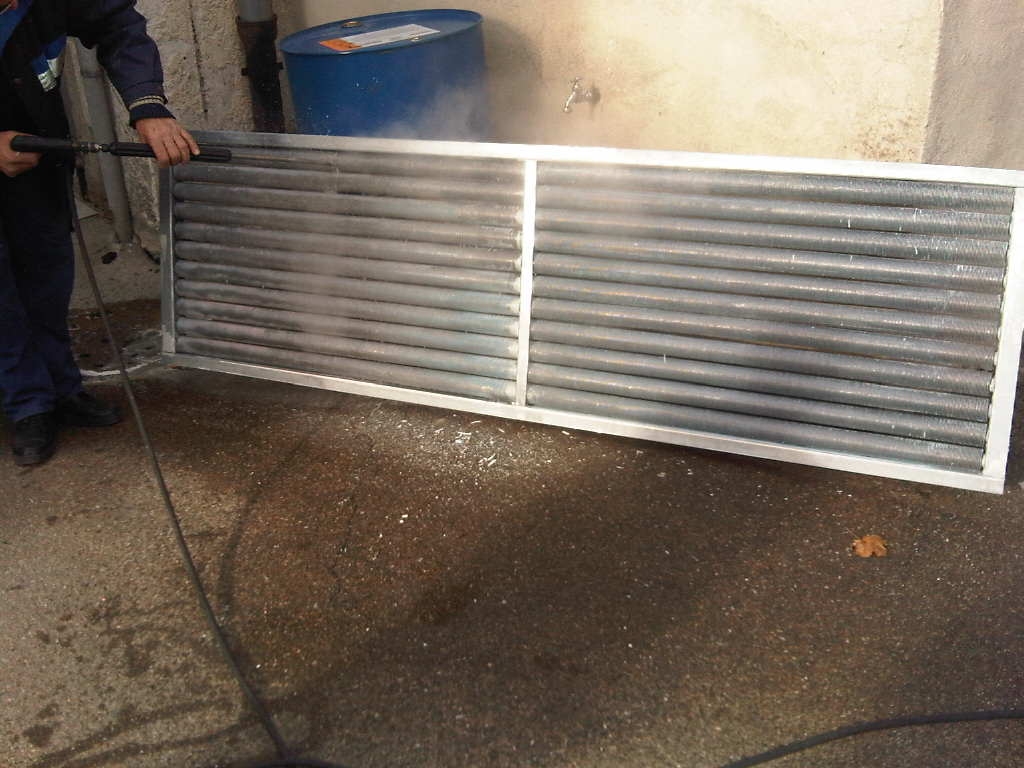
Low-pressure hot-water cleaning offers an alternative that is both gentle and economical: even fine fins are reached and cleaned without damage at a low pressure of up to 7.5 or up to 14 bar. The high working temperature of up to 95 °C dissolves oily contamination quickly and efficiently. With the right nozzles, cleaning also reaches between plates and fins; if required, an alkaline or acidic cleaner is dosed in at low concentration.
Contamination is loosened and carried away at low pressure and with low water consumption. The process water can be reconditioned by a recycling process in the unit, which saves disposal costs and protects the environment. Particularly practical: even large and unwieldy heat exchangers can be cleaned on site, as the ph-cleantec units are mobile and, thanks to their own tanks, largely self-sufficient. This eliminates removal and travel times, and the heat exchangers can be reinstalled straight away.
YOUR BENEFITS
- Fast, thorough and yet gentle: the low pressure protects fins and sensitive structures, while the high temperature achieves an outstanding cleaning effect.
- Mobile and flexible: cleaning directly on site, in many cases without removal – reducing downtime, reinstallation and travel times.
- Resource-saving: only around 1.8–2.8 litres of water per minute; thanks to the circuit recycling, usually over 99% of the resources of a high-pressure cleaner can be saved.
- Environmentally and health-friendly: hardly any chemicals, and if so, at most 1–3% alkaline cleaner instead of aggressive solvents.
- Greater occupational safety: no dangerous splash-back, no chemical vapours or aerosols.
- Economical: often 80% and more time saved, no costs for aggressive chemicals – amortisation is usually under one year.
WHICH DEVICE IS RECOMMENDED?
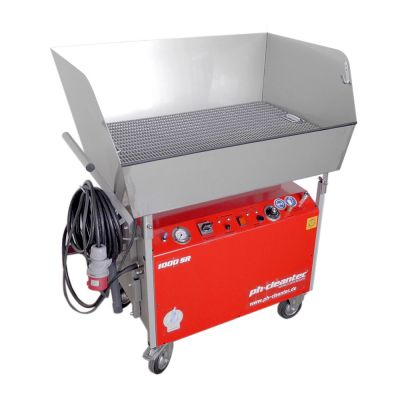
In practice, our 1000 SR units (up to 7.5 bar) or our 1500 SR-DP units (up to 14 bar) are mostly used. For large heat exchangers, a combination of a stationary tray and a mobile cleaning unit is recommended:
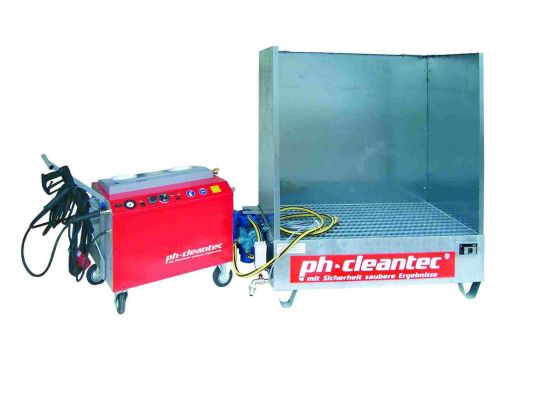
Conventional methods are often costly, resource-intensive and risky for the sensitive components. Low-pressure hot-water cleaning from ph-cleantec, by contrast, cleans heat exchangers fast, thoroughly and gently – directly on site, economically and in an environmentally friendly way. Not only heat exchangers, but the entire plant cleaning succeeds this way without aggressive chemicals.
Frequently asked questions about heat-exchanger cleaning
How do you clean heat exchangers gently, without damaging the fins?
Does the heat exchanger have to be removed for cleaning?
Which types of contamination can be removed?
Is the method also suitable for aluminium or copper heat exchangers?
How economical is heat-exchanger cleaning?
Which unit is suitable for heat-exchanger cleaning?


Test your parts in a free demonstration
We clean with your specific contamination on site – so you see the result directly.
Request a free demonstrationCalculate amortisation for your case