
Heat exchanger cleaning
Contamination in the heat exchanger lowers the efficiency and increases energy consumption. The cleaning systems from ph-cleantec remove deposits efficiently, gently and without aggressive chemicals – directly in the installed state and without laborious dismantling.

Heat exchangers in industry: types and areas of use
Heat exchangers are indispensable components in many industrial processes. Their task is to transfer heat from one medium to another without the two media coming into direct contact. In the metalworking or machining industry, they are often used to cool the cooling lubricants in precision-mechanical applications.
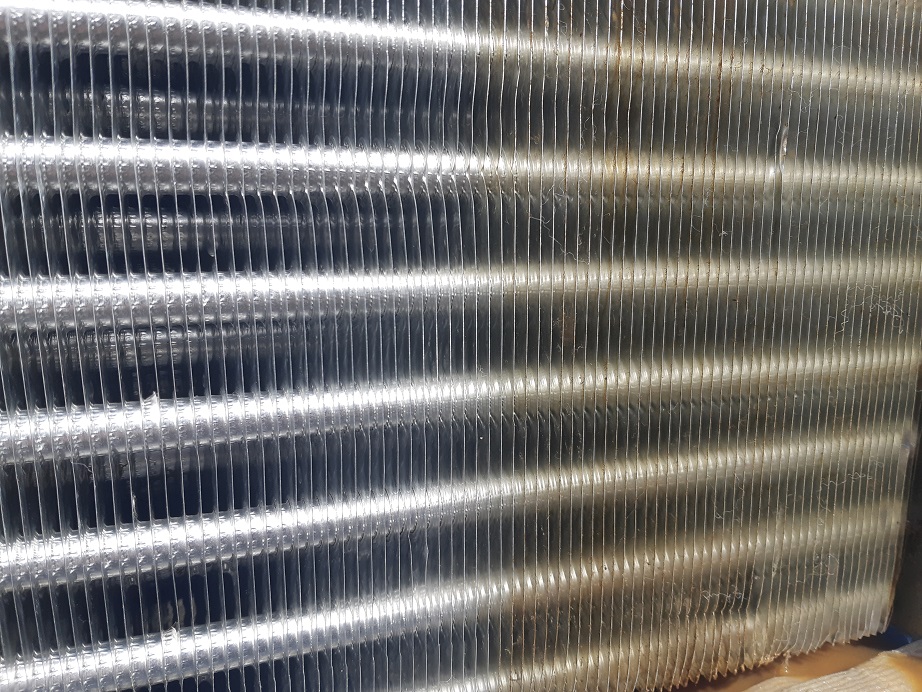
To achieve the temperature exchange between cold and warm medium, heat exchangers need large surfaces. This is generally achieved by fine fins.
The units are offered in the most varied designs and used in a multitude of areas:
- Water coolers, charge-air coolers and fuel coolers are frequently found in automotive and mechanical-engineering plants.
- Engine-oil coolers, gearbox-oil coolers and condensers are used in various industrial applications, such as in the chemical industry and in power plants.
- In air-conditioning and refrigeration technology, heat exchangers are used in the form of evaporators and condensers.
In metalworking, especially in the cooling of cooling lubricants, heat exchangers play a decisive role in cooling cooling lubricants down again after use at the cutting edge.
Cleaning heat exchangers – why and, above all: how?
Heat exchangers are particularly susceptible to contamination that impairs their efficiency and can lead to a multitude of problems. The most common types of contamination of heat exchangers are deposits that lodge on the heat-transfer surfaces over time. These deposits can take various forms:
- Limescale deposits, which occur primarily in water-carrying systems.
- Rust, especially in systems that come into contact with metals.
- Oil and grease residues from industrial processes.
- Sludge, which settles out of process wastewater.
Biological films such as algae and bacteria, which thrive in damp environments.
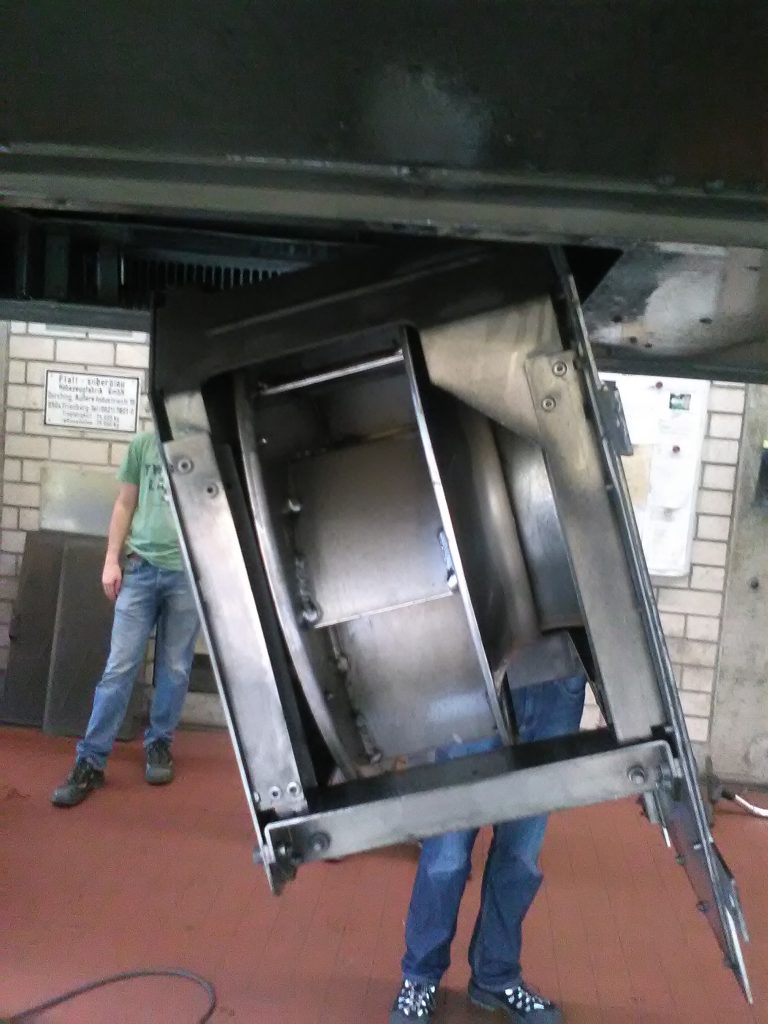
These deposits act like an insulating layer that hinders heat transfer. This leads to falling efficiency, increased energy consumption and, in many cases, also to overheating of the systems in which the heat exchangers are used. This in turn can accelerate their wear and cause failures.
Traditionally, heat exchangers are cleaned with various methods, each of which has its own advantages and disadvantages:
- Mechanical cleaning: high-pressure cleaners, brushes or even sandblasters are used here. However, these methods can damage the sensitive fins and structures of the heat exchangers.
- Chemical cleaning: in some cases, aggressive cleaning agents or acids are used to loosen deposits. However, this can attack the materials of the heat exchangers, especially with more sensitive materials such as aluminium or copper, and is also associated with high costs for the chemicals, their handling and their disposal.
- Ultrasonic or bath cleaning: these processes are effective, but often very expensive and time-consuming. In addition, they require the removal of the heat exchangers, which costs working time and leads to longer downtimes.
- Thermal processes: pyrolysis furnaces or thermal systems are used to burn off stubborn deposits. This method too is stationary and requires the removal of the heat exchangers, and as with ultrasonic cleaning, significant investment is required for the corresponding systems.
These traditional methods are cost- and/or capital-intensive, can shorten the service life of the heat exchangers, and in any case burden the environment.
What are the benefits of the ph-cleantec method?
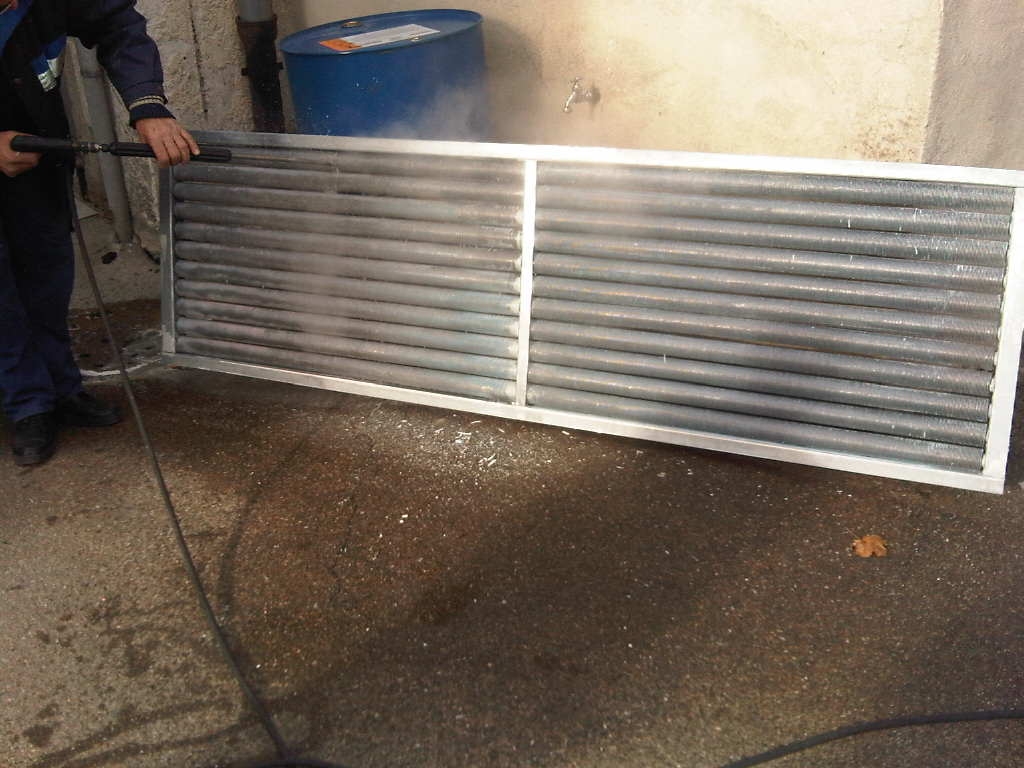
ph-cleantec GmbH has developed an innovative solution that addresses all these problems. The company relies on low-pressure hot-water cleaning with temperatures of up to 95°C and a pressure of up to 7.5 or up to 14 bar. This method offers numerous benefits over conventional processes:
- Fast, thorough and yet gentle: the low pressure prevents the fins and sensitive structures of the heat exchangers from being damaged, while the high temperatures achieve an outstanding cleaning effect.
- Mobile and flexible: with the mobile cleaning units such as the 1000 SRE or the SR series, cleaning can take place directly on site. In many cases the removal of the heat exchangers is unnecessary, which reduces the downtimes of the machines and eliminates the removal and reinstallation times as well as the travel times of the employees.
- Resource-saving: the water consumption is only 1.8–2.8 litres per minute, which means a considerable saving compared with traditional high-pressure cleaners. In addition, the water is recycled in a circuit system, so that usually over 99% of the resources for a high-pressure cleaner can be saved.
- Environmentally and health-friendly: the method uses hardly any chemicals, and if so, then at most 1–3% alkaline cleaner (soap) instead of aggressive and expensive solvents (white spirit). This spares the environment, and the health of the employees is not burdened by harmful chemicals.
- Occupational safety: because of the low pressure, no dangerous splash-back occurs, and by doing without aggressive solvents (white spirit), the employees are not exposed to dangerous chemical vapours or aerosols. This makes the working environment significantly safer and the work significantly more pleasant.
- Economical and time-saving: thanks to the high efficiency and the mobility of the units, cleaning is generally carried out much faster and more cost-effectively. In many cases, working times can be reduced by 80% and more. In addition, aggressive chemicals can be dispensed with entirely. This eliminates the costs for acquisition, handling and disposal. The amortisation period is thus, in most cases, under one year.
Use in practice
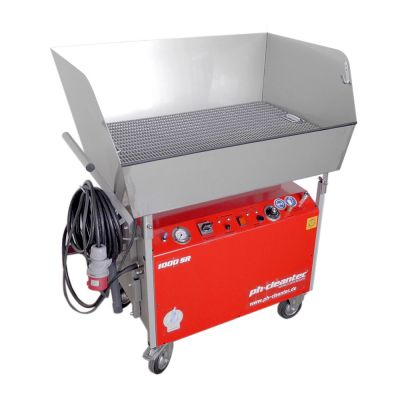
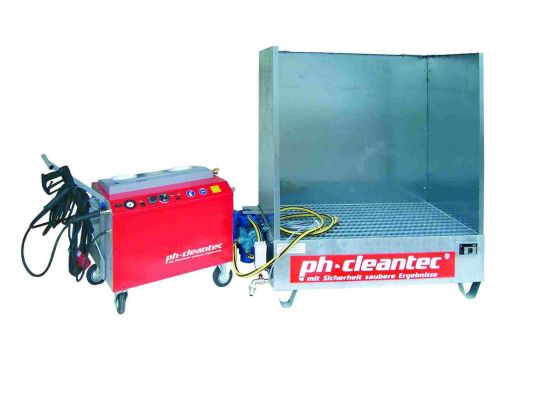
In practice, our 1000 SR units (up to 7.5 bar) or our 1500 SR-DP units (up to 14 bar) are mostly used
For large heat exchangers, on the other hand, a combination of stationary tray and mobile cleaning unit is recommended:
Conclusion
Cleaning heat exchangers is an indispensable part of maintenance in many industrial applications. Conventional methods are often costly, resource-intensive and risky for the sensitive components. In contrast, ph-cleantec GmbH offers a state-of-the-art and cost-efficient alternative: with low-pressure hot-water cleaning, a fast, thorough and gentle cleaning is made possible directly on site. This method is not only cost-effective and efficient, but also environmentally friendly, health-friendly and resource-saving.
Test your parts in a free demonstration
We clean with your specific contamination on site – so you see the result directly.
Request a free demonstrationCalculate amortisation for your case