
Cleaning in sausage production
REQUIREMENTS
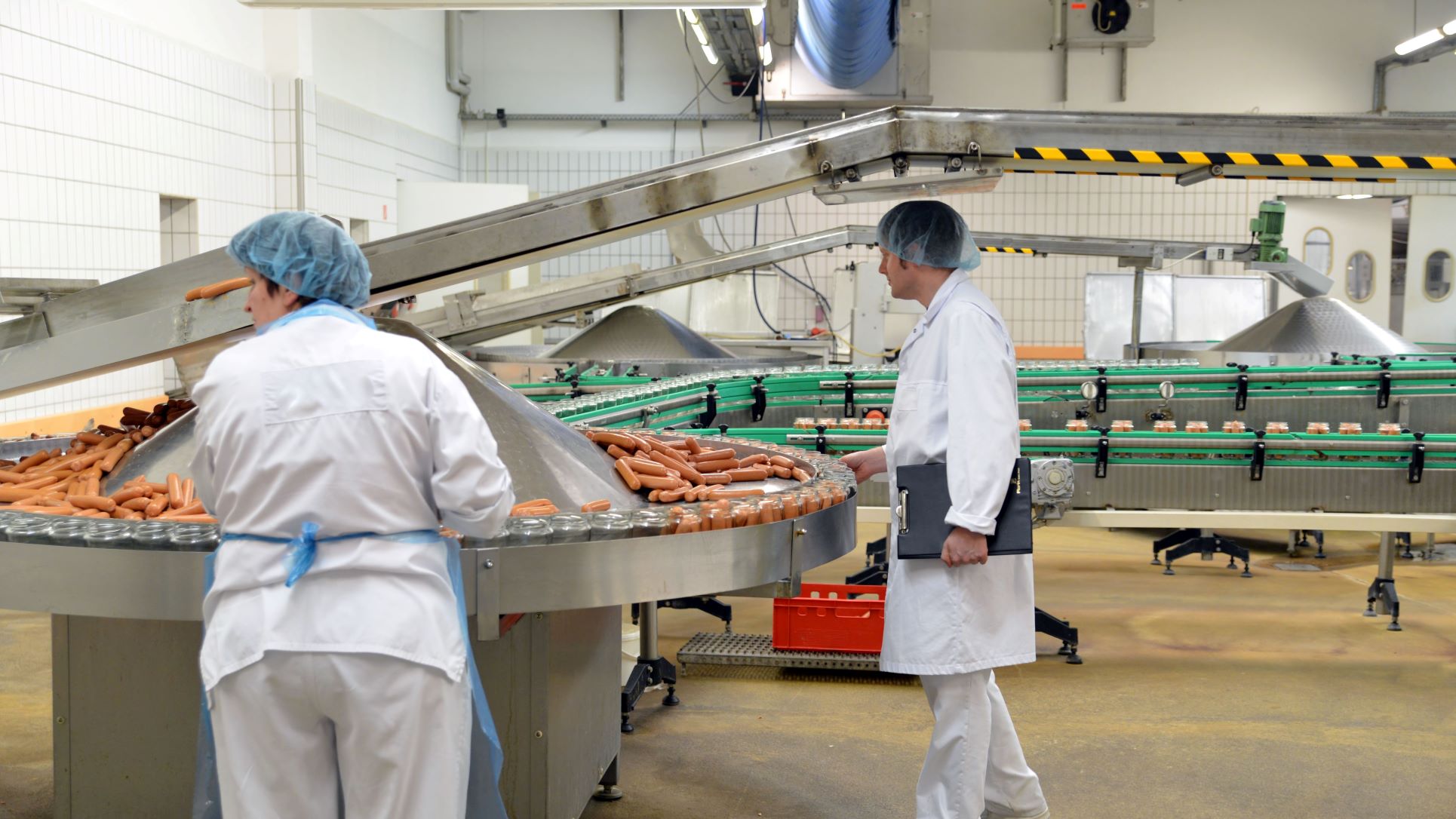
The majority of the operating plant of an industrial butchery consists of systems for processing raw and/or cooked meat and sausage products by kneading, cooking, filling, packaging and/or vacuum-packing.
The maintenance and upkeep effort for these systems is immense, especially as the particularly high hygiene demands of the food industry have to be met. This applies in particular to the contact areas, i.e. the areas that come into direct contact with the food itself.
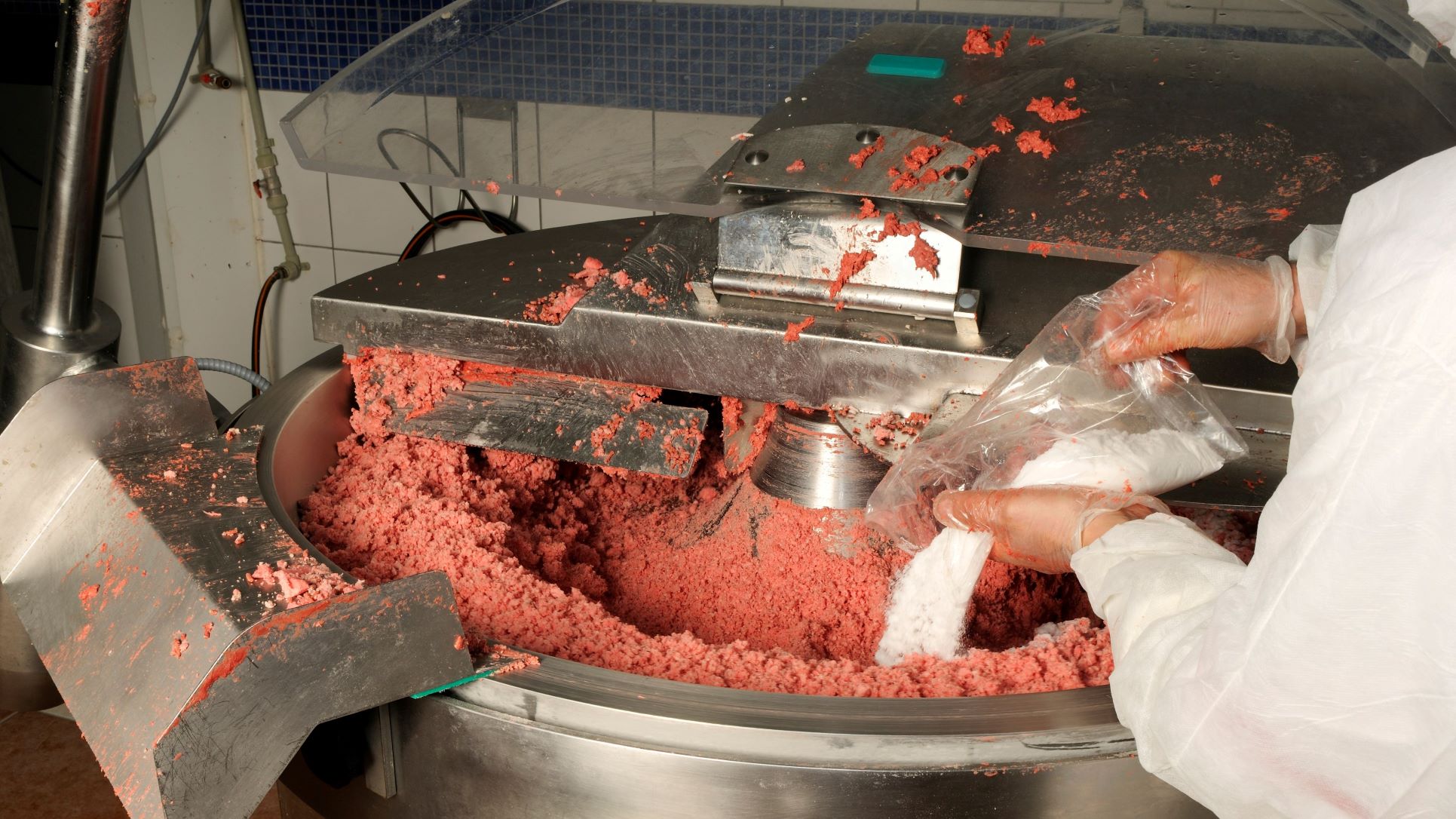
The contact areas primarily include the meat-processing systems such as the mincer and the bowl cutters, as well as the conveyor systems and the filling and packaging systems. Primary animal fat and protein compounds are cleaned. The inside of the lines is often cleaned continuously with medium pressure (CIP – cleaning in place).
The surroundings of the packaging systems are kept clean with a medium-pressure cleaner (MDR, 30 to 70 bar, max. 100 l/min); high-pressure cleaners are no longer in use because of the damage they frequently cause to the machines.
The water is generated from the company’s own processes and is about 60°C hot. There is no disposal problem, because drainage present in the production leads the wastewater into a central grease separator.
Furthermore, large butcheries and sausage-filling operations also maintain their own vehicle fleets.
OUR SOLUTION
The low-pressure hot-water cleaning technology works with low pressure of up to 7.5 or up to 14 bar and is thus ideal for use in a production hall, since no splashes occur “right across the production”, and sensitive parts are not damaged.
What is also important in practice is that cleaning can be carried out without any chemicals, since the actual cleaning takes place primarily through the high temperatures of up to 95°C – entirely without chemicals. As a result, no contamination can occur, and considerable costs are saved.
In addition, parts that cannot be dismantled, or only with considerable effort, because of their size – such as conveyor screws, motors or presses – can be cleaned “on site” without any problem thanks to the mobility of the low-pressure hot-water units, without having to be removed.
Indeed, cleaning even at hard-to-reach spots, such as at and in the conveyor screws, at the mincer, at the bowl cutters, or under the belts, is possible without any problem with the help of the right lances and nozzles. The mincer and bowl cutters, for example, are freed of the sausage meat without residue.
Cleaning with the low-pressure hot-water process is in practice also many times faster and more thorough than the previously usual manual cleaning. This saves working time and thus money, and helps in meeting the required hygiene standards.
On top of this, the process develops a disinfecting effect, since at a temperature of 95°C germs and bacteria are also killed.
YOUR BENEFITS
- Efficiency/quality: Fast and thorough cleaning: easy even in hard-to-reach or sensitive areas, such as the meat-processing systems like the mincer and conveyor screws, or the drives of the filling and packaging machines.
- Optimal accessibility: Units are mobile and largely self-contained, and can therefore be driven up to the spots to be cleaned without any problem.
- Cleaning in the production hall: no spraying of the cleaning medium right across the production hall, minimal splash-back effects, no droplet clouds, no aerosols and much more.
- Use on most machines possible even during ongoing production, e.g. on conveyor belts.
- Considerably more pleasant work than by hand or with chemicals.
- No damage to sensitive parts.
- Ideal also for servicing, maintenance and repairs.
- Cleaning medium: Hot water or deionised water, without added chemicals. Therefore:
- Thorough, fast and efficient.
- No contamination risk.
- Low costs for procurement and disposal.
- Spontaneous use in an emergency possible at any time.
- Disinfecting effect.
- Environmentally friendly and health-friendly: No chemicals means higher environmental compatibility, higher occupational safety and significantly lower costs.
- Overall: Considerably less working time when cleaning, thus fewer stoppages; better cleaning result; no chemicals, no damage.
- Low investment and hardly any running costs, but in return high efficiency and quality.
Watch the video from the real environment here!
Cleaning in a sausage factory – YouTube
Cleaning in a sausage factory phcleantec
DOWNLOAD
Cleaning at a sausage producer (PDF)Test your parts in a free demonstration
We clean with your specific contamination on site – so you see the result directly.
Request a free demonstrationCalculate amortisation for your case